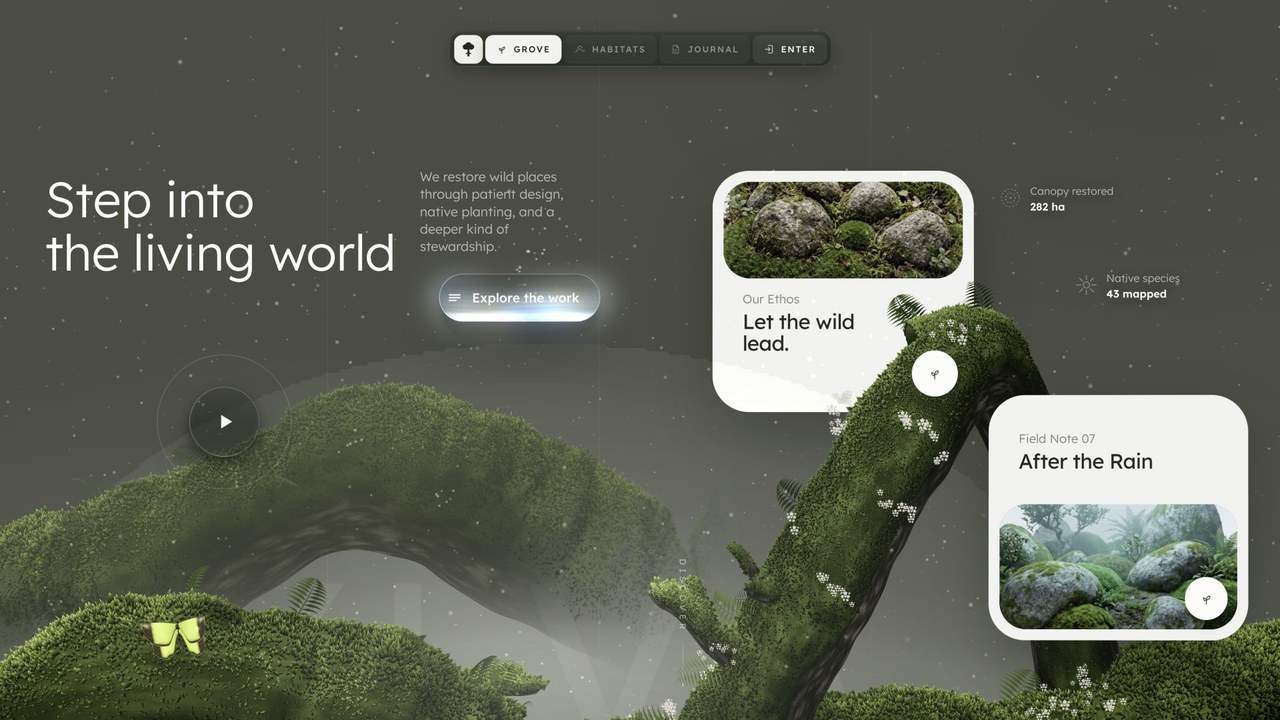
类型:3D · 分类:Hero · 收录:2026-09-16 20:35:01 · 源码:会员可见
# Sylva
The complete Sylva Living Green page, preserved with its Three.js scene, local typography, card imagery, and embedded liquid-metal buttons. The moss-root world with pale flowers, ferns, drifting pollen, the landing butterfly, and native liquid-metal controls behind the full hero layout.
> 来源:ThreeUI Community · https://threeui.com · MIT License(Meng To / Design+Code)
> 组件页:https://threeui.com/component/sylva-hero · 预览动画:https://threeui.com/previews/sylva-hero.webm
> 分类:Hero
> 包含变体(1):living-green
/* ===== public/landing-pages/inner-green-3d.html (html) ===== */
<!DOCTYPE html>
<html lang="en">
<head>
<meta charset="utf-8">
<meta name="viewport" content="width=device-width, initial-scale=1, viewport-fit=cover">
<title>Sylva — Into the living world</title>
<meta name="description" content="Restoring wild places through patient design, native planting, and a deeper kind of stewardship.">
<link rel="icon" href="data:image/svg+xml,%3Csvg xmlns='http://www.w3.org/2000/svg' viewBox='0 0 22 24'%3E%3Crect width='22' height='24' fill='%234a4d44'/%3E%3Cpath fill='%23fff' d='M11 1.3c-2.1 0-3.95 1.2-4.75 2.95C3.95 4.55 2.3 6.25 2.3 8.35c0 2.3 1.9 4.2 4.3 4.2h8.8c2.4 0 4.3-1.9 4.3-4.2 0-2.1-1.65-3.8-4-4.1C14.95 2.5 13.1 1.3 11 1.3Z'/%3E%3Cpath fill='%23fff' d='M9.6 12.55h2.8v4.2c1.35.3 2.45 1.15 3.15 2.4-1.35.4-2.4.15-3.15-.4v4.15H9.6v-4.15c-.75.55-1.8.8-3.15.4.7-1.25 1.8-2.1 3.15-2.4v-4.2Z'/%3E%3C/svg%3E">
<script>document.documentElement.className += " js";</script>
<style>
@font-face{
font-family:'Lexend';
src:url('inner-green-assets/lexend-latin.woff2') format('woff2');
font-weight:100 900; font-style:normal; font-display:swap;
unicode-range:U+0000-00FF,U+0131,U+0152-0153,U+02BB-02BC,U+02C6,U+02DA,U+02DC,U+0304,U+0308,U+0329,U+2000-206F,U+20AC,U+2122,U+2191,U+2193,U+2212,U+2215,U+FEFF,U+FFFD;
}
/* ── design unit: 1u === 1px on the 1600 × 880 reference frame ───────── */
:root{
--u: calc(100vw / 1600);
--ink: #ffffff;
--ink-soft: rgba(255,255,255,.62);
--ink-faint: rgba(255,255,255,.44);
--rule: rgba(255,255,255,.055);
--card: #f2f3ef;
--card-ink: #23261f;
--card-label: #7c8177;
--ease: cubic-bezier(.22,.61,.36,1);
--ease-out: cubic-bezier(.16,1,.3,1);
}
@media (min-width:1900px){ :root{ --u: calc(1900px / 1600); } }
*,*::before,*::after{ box-sizing:border-box; margin:0; padding:0; }
html{ background:#383b34; }
body{
font-family:'Lexend',-apple-system,BlinkMacSystemFont,'Segoe UI',sans-serif;
font-weight:300;
color:var(--ink);
background:#383b34;
overflow-x:hidden;
-webkit-font-smoothing:antialiased;
-moz-osx-font-smoothing:grayscale;
}
/* ── hero shell ──────────────────────────────────────────────────────── */
.hero{
position:relative;
width:100%;
height:100svh;
min-height:calc(880 * var(--u));
overflow:hidden;
isolation:isolate;
/* the reference screen reads a near-flat #4a4d44 corner to corner —
all the modelling comes from the light pool the root sits in */
background:
radial-gradient(64% 52% at 27% 84%, rgba(232,238,222,.085) 0%, rgba(232,238,222,0) 72%),
radial-gradient(70% 60% at 92% 8%, rgba(24,28,20,.10) 0%, rgba(24,28,20,0) 68%),
#4a4d44;
}
/* The floor of light the root stands in. Sampled off the reference: the
background climbs from 73 luma at the nav to ~128 at y 850, brightest
around the middle of the bottom edge. */
.hero::after{
content:'';
position:absolute; inset:0;
background:
radial-gradient(72% 44% at 50% 117%, rgba(238,243,231,.50) 0%, rgba(238,243,231,.21) 42%, rgba(238,243,231,.04) 72%, rgba(238,243,231,0) 88%),
linear-gradient(180deg, rgba(238,243,231,0) 54%, rgba(238,243,231,.03) 78%, rgba(238,243,231,.085) 100%);
pointer-events:none; z-index:0;
}
/* The whole composition lives on a centred 1600 × 880 stage.
Centred with margins rather than a transform on purpose: a transform would
open a stacking context and trap every child below #scene. */
.stage{
position:absolute; left:50%; top:50%;
margin-left:calc(-800 * var(--u));
margin-top:calc(-440 * var(--u));
width:calc(1600 * var(--u));
height:calc(880 * var(--u));
}
/* ── column guides (z 1) ─────────────────────────────────────────────── */
.guides{ position:absolute; inset:calc(-40 * var(--u)) 0; z-index:1; pointer-events:none; }
.guides i{
position:absolute; top:0; bottom:0; width:1px;
background:linear-gradient(180deg, rgba(255,255,255,0) 0%, var(--rule) 12%, var(--rule) 78%, rgba(255,255,255,0) 100%);
}
/* ── ghost wordmark (z 1) ────────────────────────────────────────────── */
.ghost{
position:absolute; z-index:1;
left:calc(6 * var(--u)); bottom:calc(-64 * var(--u));
font-size:calc(310 * var(--u));
line-height:.78;
font-weight:400;
letter-spacing:calc(30 * var(--u));
color:rgba(255,255,255,.055);
white-space:nowrap; user-select:none; pointer-events:none;
}
/* ── three.js canvas (z 3 — above card 1, below everything else) ─────── */
#scene{
position:absolute; inset:0; z-index:3;
width:100%; height:100%;
pointer-events:none;
opacity:0; transition:opacity .7s var(--ease);
}
.is-ready #scene{ opacity:1; }
/* ── nav: a floating dock (z 5) ──────────────────────────────────────
A centred capsule of pills that magnify as the pointer nears them, over
a rim highlight that tracks where the pointer is — the dock idiom from
ascii-page-transition, in this page's palette and unit system.
The wrapper does the centring so the capsule itself is free to carry the
pointer-parallax transform; putting both on one element means whichever
is written last wins and the dock jumps out of centre. */
.dock-wrap{
position:absolute; z-index:5;
top:calc(38 * var(--u)); left:0; right:0;
display:flex; justify-content:center;
pointer-events:none;
}
.dock{
pointer-events:auto;
display:flex; align-items:flex-start; gap:calc(3 * var(--u));
height:calc(46 * var(--u));
padding:calc(5 * var(--u));
border-radius:calc(14 * var(--u));
border:1px solid rgba(255,255,255,.11);
/* No backdrop-filter. It sits over a canvas that repaints every frame,
so the backdrop has to be re-sampled and re-blurred every frame too —
measured at ~20 fps off the whole page, and the radius made no
difference because the cost is the extra pass, not the blur. A
translucent panel with a lit top edge reads the same at this size. */
background:
linear-gradient(180deg, rgba(255,255,255,.055), rgba(255,255,255,0) 42%),
rgba(34,40,31,.74);
box-shadow:0 calc(8 * var(--u)) calc(22 * var(--u)) rgba(10,14,8,.30),
inset 0 1px rgba(255,255,255,.06);
isolation:isolate;
}
/* Anchored at the top so growth runs downward, out of the headline's way —
a dock that grew from its centre would push into the nav's own row. */
.dock-item{
position:relative; z-index:6;
display:inline-flex; align-items:center; justify-content:center;
flex:none;
height:calc(36 * var(--u));
gap:calc(8 * var(--u));
padding:0 calc(13 * var(--u));
transform-origin:50% 0;
border:1px solid transparent;
border-radius:calc(10 * var(--u));
background:rgba(255,255,255,.04);
color:var(--ink-faint);
text-decoration:none; cursor:pointer;
font-family:inherit;
font-size:calc(11 * var(--u)); font-weight:500;
letter-spacing:calc(1.5 * var(--u)); text-transform:uppercase;
white-space:nowrap;
will-change:width,height,transform;
transition:color .18s var(--ease), border-color .2s var(--ease), background .2s var(--ease);
}
/* A magnified pill hangs below the capsule, so it needs to be its own
opaque tile — a translucent white wash at that size reads as a milky
rectangle stuck to the bar rather than as a key lifting off it. */
.dock-item[data-near="true"]{
z-index:7;
color:var(--ink);
border-color:rgba(255,255,255,.19);
background:rgba(31,37,28,.94);
box-shadow:0 calc(7 * var(--u)) calc(16 * var(--u)) rgba(10,14,8,.30);
}
.dock-item .glyph{
width:calc(14 * var(--u)); height:calc(14 * var(--u)); flex:none;
opacity:.66; transition:opacity .18s var(--ease);
}
.dock-item .glyph svg{
display:block; width:100%; height:100%;
fill:none; stroke:currentColor; stroke-width:1.25;
stroke-linecap:round; stroke-linejoin:round;
}
.dock-item[data-near="true"] .glyph{ opacity:1; }
/* the mark is the dock's anchor: a solid pale tile, the one opaque thing
in a bar made of glass */
.dock-mark{
width:calc(36 * var(--u)); padding:0;
background:#eef1e7; border-color:#eef1e7; color:#23261f;
overflow:hidden;
}
.dock-mark svg{ width:58%; height:58%; display:block; fill:currentColor; }
/* the near state paints .dock-item white, which on the pale mark tile
would be a white glyph on a white ground */
.dock-mark[data-near="true"]{ background:#fff; border-color:#fff; color:#1b1e18; }
/* the current section wears the cards' paper, so the nav and the cards
read as the same material */
.dock-item.is-active{
background:var(--card); border-color:var(--card); color:var(--card-ink);
box-shadow:0 calc(6 * var(--u)) calc(16 * var(--u)) rgba(12,17,9,.24);
}
.dock-item.is-active .glyph{ opacity:.8; }
.dock-item--enter{ color:var(--ink); background:rgba(255,255,255,.075); }
/* ── specular rim ────────────────────────────────────────────────────
A conic gradient masked down to the border, whose start angle points at
the pointer and whose opacity falls off with distance. It is the reason
the glass reads as a lit edge rather than as a flat translucent box. */
[data-spec]{ --spec-angle:2.4rad; --spec-bright:0; }
[data-spec]::after{
content:''; position:absolute; inset:-1px; z-index:5;
padding:1px; border-radius:inherit; pointer-events:none;
opacity:var(--spec-bright);
background:conic-gradient(from var(--spec-angle) at 50% 50%,
rgba(240,246,232,0) 0deg, rgba(240,246,232,.08) 14deg, rgba(240,246,232,.95) 28deg,
rgba(240,246,232,.16) 46deg, rgba(240,246,232,0) 68deg, rgba(240,246,232,0) 180deg,
rgba(240,246,232,.08) 194deg, rgba(240,246,232,.95) 208deg, rgba(240,246,232,.16) 226deg,
rgba(240,246,232,0) 248deg, rgba(240,246,232,0) 360deg);
-webkit-mask:linear-gradient(#000 0 0) content-box, linear-gradient(#000 0 0);
mask:linear-gradient(#000 0 0) content-box, linear-gradient(#000 0 0);
-webkit-mask-composite:xor; mask-composite:exclude;
}
.dock{ position:relative; }
/* ── hero copy (z 4) ─────────────────────────────────────────────────── */
.headline{
position:absolute; z-index:4;
left:calc(46 * var(--u)); top:calc(202 * var(--u));
font-size:calc(63 * var(--u)); line-height:calc(65 * var(--u));
font-weight:300; letter-spacing:calc(-0.4 * var(--u));
color:var(--ink);
}
/* No overflow clip: cropping a 63u face to wipe it in cuts the descenders
of "Step" and "living" at the moment they land. The padding stays even
though the clip is gone — it set the two lines' metrics, and removing it
would shift line two. */
.headline span{ display:block; padding-bottom:.04em; }
.headline span i{ display:inline-block; font-style:normal; }
.lede{
position:absolute; z-index:4;
left:calc(520 * var(--u)); top:calc(196 * var(--u));
width:calc(208 * var(--u));
font-size:calc(16.5 * var(--u)); line-height:calc(22 * var(--u));
font-weight:300; color:var(--ink-soft);
}
/* ── liquid-metal controls ──────────────────────────────────────────
The original five-pass WebGL2 renderer now mounts directly in this
document. Its canvas, sizing, glass plate, shader constants and input
model are unchanged; only the iframe boundary has been removed. */
.pill-clip{
position:absolute; z-index:4;
left:calc(644 * var(--u)); top:calc(360 * var(--u));
width:calc(410 * var(--u)); height:calc(270 * var(--u));
margin:calc(-135 * var(--u)) 0 0 calc(-205 * var(--u));
clip-path:inset(calc(72 * var(--u)) calc(60 * var(--u))
calc(26 * var(--u)) calc(60 * var(--u)) round calc(62 * var(--u)));
}
.pill{
position:absolute; inset:0; --mr:calc(150 * var(--u));
display:grid; place-items:center;
}
.liquid-stage{
--lu:calc(var(--h) / 516);
--bh:var(--h);
--pad:calc(900 * var(--lu));
position:relative;
width:max-content; height:max-content;
padding:var(--pad);
display:grid; place-items:center;
touch-action:manipulation;
font-family:'Lexend','Inter',-apple-system,BlinkMacSystemFont,'Helvetica Neue',Arial,sans-serif;
font-optical-sizing:auto;
-webkit-font-smoothing:antialiased;
}
.liquid-stage--explore{ --h:calc(60.156 * var(--u)); }
.liquid-stage--play{ --h:calc(88.2288 * var(--u)); }
.liquid-plate{
position:absolute;
inset:var(--pad);
border-radius:999px;
background:
linear-gradient(180deg, rgba(255,255,255,.085), rgba(255,255,255,.014) 44%, rgba(255,255,255,0) 64%),
rgba(10,12,10,.42);
box-shadow:
0 calc(var(--h) * 0.08) calc(var(--h) * 0.18) rgba(0,0,0,.38),
0 calc(var(--h) * 0.24) calc(var(--h) * 0.50) rgba(0,0,0,.28),
0 calc(var(--h) * 0.48) calc(var(--h) * 0.96) rgba(0,0,0,.16),
inset 0 1px 0 rgba(255,255,255,.13),
inset 0 calc(var(--h) * -0.02) calc(var(--h) * 0.05) rgba(255,255,255,.05);
transition:box-shadow .38s cubic-bezier(.22,.61,.36,1),
background .38s cubic-bezier(.22,.61,.36,1);
}
.liquid-stage.hot .liquid-plate{
background:
linear-gradient(180deg, rgba(255,255,255,.105), rgba(255,255,255,.02) 44%, rgba(255,255,255,0) 64%),
rgba(8,10,8,.50);
box-shadow:
0 calc(var(--h) * 0.10) calc(var(--h) * 0.22) rgba(0,0,0,.44),
0 calc(var(--h) * 0.32) calc(var(--h) * 0.66) rgba(0,0,0,.34),
0 calc(var(--h) * 0.66) calc(var(--h) * 1.32) rgba(0,0,0,.20),
inset 0 1px 0 rgba(255,255,255,.17),
inset 0 calc(var(--h) * -0.02) calc(var(--h) * 0.05) rgba(255,255,255,.06);
}
.liquid-fx{ position:absolute; inset:0; width:100%; height:100%; display:block; }
.liquid-button{
position:relative;
height:var(--bh);
border:0; background:none;
border-radius:999px;
display:flex; align-items:center; justify-content:center;
color:#fff;
font-family:inherit; font-weight:500; line-height:1; letter-spacing:0;
cursor:pointer; -webkit-tap-highlight-color:transparent; outline:none;
}
.liquid-button:focus-visible{
outline:calc(4 * var(--lu)) solid rgba(255,255,255,.55);
outline-offset:calc(10 * var(--lu));
}
.liquid-button .ico{ display:block; flex:none; overflow:visible; }
.liquid-button .lbl{ display:block; transform:translateY(calc(2 * var(--lu))); }
.liquid-button--explore{
padding:0 calc(224 * var(--lu)) 0 calc(95 * var(--lu));
gap:calc(112 * var(--lu));
font-size:calc(140 * var(--lu));
}
.liquid-button--explore .ico{
width:calc(150 * var(--lu)); height:calc(150 * var(--lu));
}
.liquid-button--play{
width:var(--bh); height:var(--bh); padding:0;
}
.liquid-button--play .ico{
width:calc(176 * var(--lu)); height:calc(176 * var(--lu));
margin-left:calc(14 * var(--lu));
}
.liquid-button--play .lbl{ display:none; }
.liquid-stage.press .liquid-plate{
background:
linear-gradient(180deg, rgba(255,255,255,.07), rgba(255,255,255,.01) 44%, rgba(255,255,255,0) 64%),
rgba(7,9,7,.55);
box-shadow:
0 calc(var(--h) * 0.04) calc(var(--h) * 0.11) rgba(0,0,0,.46),
0 calc(var(--h) * 0.13) calc(var(--h) * 0.32) rgba(0,0,0,.36),
0 calc(var(--h) * 0.27) calc(var(--h) * 0.62) rgba(0,0,0,.22),
inset 0 1px 0 rgba(255,255,255,.10);
transition-duration:.10s;
}
/* ── play button (z 4) ─────────────────────────────────────────────── */
.play-wrap{
position:absolute; z-index:4; pointer-events:none;
left:calc(187 * var(--u)); top:calc(431 * var(--u));
width:calc(170 * var(--u)); height:calc(170 * var(--u));
}
.play-wrap > *{ pointer-events:auto; }
.play-clip{
position:absolute; left:50%; top:50%;
width:calc(396 * var(--u)); height:calc(396 * var(--u));
margin:calc(-198 * var(--u)) 0 0 calc(-198 * var(--u));
clip-path:inset(calc(131 * var(--u)) calc(106 * var(--u))
calc(73 * var(--u)) calc(106 * var(--u)) round calc(92 * var(--u)));
}
.play-glass{ position:absolute; inset:0; display:grid; place-items:center; }
.play-ring{
position:absolute; inset:0; pointer-events:none;
border:1px solid rgba(255,255,255,.17); border-radius:50%;
}
.play-ring::after{
content:''; position:absolute; inset:calc(-1 * var(--u));
border:1px solid rgba(255,255,255,.32); border-radius:50%;
opacity:0; transform:scale(.86);
transition:opacity .7s var(--ease), transform .9s var(--ease-out);
}
.play-clip:hover ~ .play-ring::after,
.play-clip:focus-within ~ .play-ring::after{ opacity:1; transform:scale(1.06); }
/* ── stats (z 4) ─────────────────────────────────────────────────────── */
.stat{ position:absolute; z-index:4; display:flex; align-items:flex-start; gap:calc(9 * var(--u)); }
.stat--a{ left:calc(1250 * var(--u)); top:calc(216 * var(--u)); }
.stat--b{ left:calc(1346 * var(--u)); top:calc(326 * var(--u)); }
.stat .mark{ width:calc(32 * var(--u)); height:calc(32 * var(--u)); flex:none; margin-top:calc(2 * var(--u)); color:rgba(255,255,255,.34); }
.stat .mark svg{ width:100%; height:100%; display:block; }
.stat dt{ font-size:calc(13.5 * var(--u)); font-weight:300; color:var(--ink-soft); line-height:calc(19 * var(--u)); }
.stat dt, .stat dd{ text-shadow:0 calc(2 * var(--u)) calc(16 * var(--u)) rgba(10,14,8,.6); }
.stat .mark svg{ filter:drop-shadow(0 calc(2 * var(--u)) calc(10 * var(--u)) rgba(10,14,8,.6)); }
.stat dd{ font-size:calc(13.5 * var(--u)); font-weight:600; color:var(--ink); line-height:calc(21 * var(--u)); }
/* ── cards ───────────────────────────────────────────────────────────── */
.card{
position:absolute;
background:var(--card); border-radius:calc(46 * var(--u));
box-shadow:0 calc(30 * var(--u)) calc(70 * var(--u)) rgba(16,21,13,.30);
transition:box-shadow .8s var(--ease);
}
/* No z-index here on purpose. z-index:auto keeps the card out of its own
stacking context, so the body paints under #scene (the moss drapes over
its shoulder) while .knob, at z 4, still sits in front of the moss. */
.card--about{
left:calc(890 * var(--u)); top:calc(200 * var(--u));
width:calc(330 * var(--u)); height:calc(305 * var(--u));
}
.card--stove{
z-index:4; will-change:transform;
left:calc(1237 * var(--u)); top:calc(482 * var(--u));
width:calc(328 * var(--u)); height:calc(310 * var(--u));
}
.card .label{
position:absolute; left:calc(38 * var(--u));
font-size:calc(15.5 * var(--u)); font-weight:300; color:var(--card-label);
}
.card h2{
position:absolute; left:calc(38 * var(--u));
font-size:calc(26.2 * var(--u)); line-height:calc(27 * var(--u));
font-weight:400; letter-spacing:calc(-0.5 * var(--u)); color:var(--card-ink);
}
.card--about .label{ top:calc(152 * var(--u)); }
.card--about h2{ top:calc(177 * var(--u)); width:calc(142 * var(--u)); }
.card--stove .label{ top:calc(45 * var(--u)); }
.card--stove h2{ top:calc(70 * var(--u)); }
/* Both cards carry a plate. The Field Note reads downward — label, title,
then the photograph — so its window sits at the foot of the card; the
Ethos card reads the other way up, so its window is at the head and the
copy sits under it. Same frame, mirrored. */
.card figure{
position:absolute; left:calc(14 * var(--u)); right:calc(14 * var(--u));
border-radius:calc(34 * var(--u)); overflow:hidden;
isolation:isolate; background:#263025;
}
.card--stove figure{ bottom:calc(14 * var(--u)); height:calc(158 * var(--u)); }
.card--about figure{ top:calc(14 * var(--u)); height:calc(122 * var(--u)); }
/* The plate is its own depth plane. It travels against the card and the
moss, so the landscape feels like a small window rather than a
photograph glued to the surface. */
.portal-media{
position:absolute; inset:calc(-9 * var(--u)); z-index:1; display:block;
will-change:transform,clip-path;
transform:
perspective(900px)
translate3d(calc(var(--px,0) * -11px),calc(var(--py,0) * -7px),0)
rotateY(calc(var(--px,0) * -1.4deg))
rotateX(calc(var(--py,0) * .9deg));
transform-origin:50% 50%;
}
.portal-media img{
width:100%; height:100%; object-fit:cover; display:block;
transform:scale(1.08);
filter:saturate(.92) contrast(1.03);
transition:transform 1.25s var(--ease-out),filter .8s var(--ease);
}
.card:hover .portal-media img{ transform:scale(1.13); filter:saturate(1.04) contrast(1.04); }
.pixel-reveal{
position:absolute; inset:0; z-index:3; width:100%; height:100%;
pointer-events:none; opacity:0; mix-blend-mode:screen;
}
/* The white scan rides the clip edge, so its centre has to travel the
media element's box, not the figure's — .portal-media is overscanned by
9u on every side to give the parallax rotation somewhere to go. Offsetting
by that 9u in calc() rather than by a translate percentage keeps the
glow on the edge at every breakpoint, whatever size the plate is. */
.card figure::after{
content:''; position:absolute; z-index:2;
filter:blur(calc(2 * var(--u))); opacity:0; pointer-events:none;
top:0; bottom:0; width:26%; left:calc(-13% - 9 * var(--u));
background:linear-gradient(90deg,transparent,rgba(229,244,209,.2) 42%,rgba(252,255,246,.72) 54%,transparent);
}
.knob-float{
position:absolute; z-index:4; pointer-events:none;
left:calc(1142 * var(--u)); top:calc(427 * var(--u));
width:calc(58 * var(--u)); height:calc(58 * var(--u));
}
.knob-float > *{ pointer-events:auto; }
.knob--about{ left:0; top:0; }
.card .knob, .knob--about{
position:absolute; z-index:4; right:calc(20 * var(--u)); bottom:calc(20 * var(--u));
width:calc(58 * var(--u)); height:calc(58 * var(--u));
border:0; border-radius:50%; cursor:pointer;
background:#fbfcf8; display:grid; place-items:center;
box-shadow:0 calc(6 * var(--u)) calc(16 * var(--u)) rgba(16,21,13,.18);
transition:transform .5s var(--ease-out), background .4s var(--ease);
}
.knob--about{ right:auto; bottom:auto; width:calc(58 * var(--u)); height:calc(58 * var(--u)); }
.card--stove .knob{ width:calc(54 * var(--u)); height:calc(54 * var(--u)); right:calc(26 * var(--u)); bottom:calc(26 * var(--u)); }
.card .knob svg, .knob--about svg{ width:calc(19 * var(--u)); height:calc(19 * var(--u)); display:block; color:#3f453a; }
.card .knob:hover, .knob--about:hover{ transform:scale(1.1) rotate(8deg); background:#fff; }
.card:hover{ box-shadow:0 calc(38 * var(--u)) calc(84 * var(--u)) rgba(16,21,13,.36); }
/* ── scroll cue (z 4) ────────────────────────────────────────────────── */
.scroll{
position:absolute; z-index:4;
left:calc(846 * var(--u)); top:calc(690 * var(--u));
display:flex; align-items:center; gap:calc(12 * var(--u));
writing-mode:vertical-rl;
font-size:calc(11 * var(--u)); font-weight:400;
letter-spacing:calc(4.4 * var(--u));
color:rgba(255,255,255,.5);
text-transform:uppercase; text-decoration:none;
}
.scroll .track{ position:relative; width:1px; height:calc(56 * var(--u)); background:rgba(255,255,255,.18); overflow:hidden; }
.scroll .track::after{
content:''; position:absolute; inset:0 0 auto; height:40%;
background:rgba(255,255,255,.75);
animation:trickle 2.6s var(--ease) infinite;
}
@keyframes trickle{
0% { transform:translateY(-105%); opacity:0; }
22% { opacity:1; }
78% { opacity:1; }
100% { transform:translateY(255%); opacity:0; }
}
/* ── entrance: everything is wiped in behind a mask ───────────────────
Transform is reserved for the pointer parallax, so the reveal is done
with clip-path. Once the intro has run, .intro-done drops the clip
entirely — a live clip-path would open a stacking context on the About
card and trap its knob under the moss. */
.js .mask{ clip-path:inset(100% 0 0 0 round var(--mr,0px)); }
.is-ready .mask{
clip-path:inset(0 0 0 0 round var(--mr,0px));
transition:clip-path 1.05s var(--ease-out) var(--d,0ms);
}
.js .mask-circle{ clip-path:circle(0% at 50% 50%); }
.is-ready .mask-circle{
clip-path:circle(76% at 50% 50%);
transition:clip-path 1.1s var(--ease-out) var(--d,0ms);
}
.js .fade{ opacity:0; }
.is-ready .fade{ opacity:1; transition:opacity 1.3s var(--ease) var(--d,0ms); }
.intro-done .mask, .intro-done .mask-circle{ clip-path:none; transition:none; }
.card{ --mr:calc(46 * var(--u)); }
/* the dock drops in tile by tile; the capsule itself only fades, because
a clip on it would cut the pills off as they magnify past its edge */
.js .dock{ opacity:0; }
.is-ready .dock{ opacity:1; transition:opacity .8s var(--ease) 80ms; }
.js .dock-item{ clip-path:inset(0 0 105% 0); }
.is-ready .dock-item{
clip-path:inset(0 0 -30% 0);
transition:clip-path .9s var(--ease-out) var(--d,0ms),
color .18s var(--ease), border-color .2s var(--ease), background .2s var(--ease);
}
.intro-done .dock-item{ clip-path:none; }
/* A short rise under a fade rather than a full-height wipe: with nothing
cropping it, a 105% travel would start line one sitting on top of line
two. .headline itself carries the pointer parallax, so the transform has
to go on the inner <i>. */
.js .headline span i{ opacity:0; transform:translateY(calc(16 * var(--u))); }
.is-ready .headline span i{
opacity:1; transform:none;
transition:opacity 1.05s var(--ease) var(--d,0ms),
transform 1.25s var(--ease-out) var(--d,0ms);
}
/* Each plate resolves like a low-bandwidth botanical transmission: a
stepped clip exposes the photograph while sampled pixel-dots gather along
the advancing edge (the dots themselves are painted by canvas).
Both plates scan across, the Ethos one a beat ahead of the Field Note. */
.js .portal-media{ clip-path:inset(0 100% 0 0 round calc(25 * var(--u))); }
.is-ready .card--about .portal-media{ animation:portal-cut 1.45s steps(12,end) .92s both; }
.is-ready .card--stove .portal-media{ animation:portal-cut 1.45s steps(12,end) 1.08s both; }
.is-ready .card--about figure::after{ animation:portal-scan 1.45s steps(12,end) .92s both; }
.is-ready .card--stove figure::after{ animation:portal-scan 1.45s steps(12,end) 1.08s both; }
.intro-done .portal-media{ clip-path:none; animation:none; }
@keyframes portal-cut{
from{ clip-path:inset(0 100% 0 0 round calc(25 * var(--u))); }
to{ clip-path:inset(0 0 0 0 round calc(25 * var(--u))); }
}
/* The glow travels by animating its own offset, not by a translate
percentage. A translate is a percentage of the glow's width, so the
distance it covers depends on the plate's proportions — it overshot by
a quarter of the card here and rode ahead of the edge the whole way.
In calc() the travel is exactly the media box: 100% of the plate plus
the 9u of overscan at each end, at every breakpoint. */
@keyframes portal-scan{
0%{ left:calc(-13% - 9 * var(--u)); opacity:0; }
10%{ opacity:.75; }
88%{ opacity:.55; }
100%{ left:calc(87% + 9 * var(--u)); opacity:0; }
}
/* No clip on the canvas: the root draws itself in behind the survey pulse,
and a CSS wipe on top of that would be two reveals fighting each other.
The fade is only here to cover the first compiled frame. */
.is-ready #scene{ transition:opacity .45s var(--ease); }
/* ── pointer parallax ────────────────────────────────────────────────
--px / --py are written on .hero once per frame (-1…1). Each layer
declares how far it rides (--pd, px at full deflection) and how much
it turns (--pr, degrees), which is what gives the plane its depth. */
.par{
transform:
perspective(1400px)
translate3d(calc(var(--px,0) * var(--pd,0) * -1px),
calc(var(--py,0) * var(--pd,0) * -0.62px),
0)
rotateY(calc(var(--px,0) * var(--pr,0) * 1deg))
rotateX(calc(var(--py,0) * var(--pr,0) * -0.7deg));
}
/* the floating knob turns about the About card's centre, not its own,
so it stays glued to the corner it belongs to */
.knob-float{ transform-origin:calc(-87 * var(--u)) calc(-74.5 * var(--u)); }
.card--about{ transform-origin:50% 50%; }
/* ── keyboard focus ──────────────────────────────────────────────────── */
a:focus-visible, button:focus-visible{
outline:2px solid rgba(255,255,255,.85);
outline-offset:calc(4 * var(--u));
border-radius:calc(6 * var(--u));
}
.card .knob:focus-visible, .knob--about:focus-visible, .play:focus-visible{ outline-color:rgba(28,34,22,.9); }
@media (prefers-reduced-motion:reduce){
.mask,.mask-circle,.fade,#scene,
.dock,.dock-item,
.headline span i{ opacity:1 !important; clip-path:none !important; transform:none !important; transition:none !important; }
.par{ transform:none !important; }
.portal-media{ clip-path:none !important; animation:none !important; transform:none !important; }
.pixel-reveal,.card figure::after{ display:none !important; }
.portal-media img{ transform:none !important; transition:none !important; }
.scroll .track::after{ animation:none; }
#scene{ transition:none; }
}
/* ── narrow screens: one column, the moss becomes a band between the
copy and the cards (760 design units wide) ───────────────────────── */
@media (max-width:900px){
:root{ --u: calc(100vw / 760); }
.hero{ height:auto; min-height:100svh; }
.stage{
position:relative; left:auto; top:auto; margin:0;
width:100%; height:calc(1625 * var(--u));
}
.hero::after{
background:
radial-gradient(90% 30% at 50% 74%, rgba(238,243,231,.40) 0%, rgba(238,243,231,.14) 46%, rgba(238,243,231,0) 82%),
linear-gradient(180deg, rgba(238,243,231,0) 62%, rgba(238,243,231,.05) 100%);
}
.guides i:nth-child(3){ display:none; }
.guides i:nth-child(1){ left:calc(253 * var(--u)) !important; }
.guides i:nth-child(2){ left:calc(506 * var(--u)) !important; }
/* one column: the labels come off and the dock keeps only its glyphs,
because at this scale the type would be four pixels tall */
/* Floored with max(), not left on the design unit alone: this breakpoint
runs from 900px down to 320px, so a pure --u dock is a 24px bar with
12px targets on a phone. The floor only bites at the small end. */
.dock-wrap{ top:calc(30 * var(--u)); }
.dock{
height:max(56px, calc(58 * var(--u)));
padding:max(6px, calc(6 * var(--u)));
gap:max(4px, calc(4 * var(--u)));
border-radius:max(17px, calc(18 * var(--u)));
}
.dock-item{
height:max(44px, calc(46 * var(--u)));
width:max(44px, calc(46 * var(--u)));
padding:0; border-radius:max(12px, calc(13 * var(--u)));
}
.dock-item span:not(.glyph){ display:none; }
.dock-item .glyph{ width:max(19px, calc(20 * var(--u))); height:max(19px, calc(20 * var(--u))); }
.dock-mark svg{ width:52%; height:52%; }
.knob-float{ left:calc(644 * var(--u)); top:calc(1218 * var(--u)); transform-origin:calc(-264 * var(--u)) calc(-43 * var(--u)); }
.headline{ left:calc(34 * var(--u)); top:calc(128 * var(--u)); font-size:calc(62 * var(--u)); line-height:calc(66 * var(--u)); }
.lede{ left:calc(34 * var(--u)); top:calc(288 * var(--u)); width:calc(400 * var(--u)); font-size:calc(19 * var(--u)); line-height:calc(27 * var(--u)); }
/* one column: the frame keeps its aspect, re-anchored to the left rail */
.pill-clip{
left:calc(34 * var(--u)); top:calc(430 * var(--u));
width:calc(506 * var(--u)); height:calc(334 * var(--u));
margin:calc(-167 * var(--u)) 0 0 calc(-79 * var(--u));
clip-path:inset(calc(93 * var(--u)) calc(74 * var(--u)) calc(1 * var(--u)) calc(74 * var(--u)) round calc(76 * var(--u)));
}
.liquid-stage--explore{ --h:calc(74.4152 * var(--u)); }
.play-wrap{ display:none; }
.stat{ gap:calc(11 * var(--u)); }
.stat .mark{ width:calc(36 * var(--u)); height:calc(36 * var(--u)); }
.stat dt{ font-size:calc(16 * var(--u)); line-height:calc(22 * var(--u)); }
.stat dd{ font-size:calc(16.5 * var(--u)); line-height:calc(24 * var(--u)); }
.stat--a{ left:calc(34 * var(--u)); top:calc(540 * var(--u)); }
.stat--b{ left:calc(396 * var(--u)); top:calc(540 * var(--u)); }
.card{ border-radius:calc(40 * var(--u)); }
.card--about{ left:calc(34 * var(--u)); top:calc(1050 * var(--u)); width:calc(692 * var(--u)); height:calc(250 * var(--u)); }
.card--about .label{ top:calc(96 * var(--u)); }
.card--about h2{ top:calc(124 * var(--u)); width:calc(400 * var(--u)); font-size:calc(32 * var(--u)); line-height:calc(36 * var(--u)); }
.card--stove{ left:calc(34 * var(--u)); top:calc(1324 * var(--u)); width:calc(692 * var(--u)); height:calc(268 * var(--u)); }
.card--stove h2{ font-size:calc(32 * var(--u)); }
/* one column: both plates become a thumbnail on the card's outer edge,
the Ethos one still anchored to the top */
.card--stove figure{ left:auto; right:calc(16 * var(--u)); bottom:calc(16 * var(--u)); width:calc(300 * var(--u)); height:calc(150 * var(--u)); }
.card--about figure{ left:auto; right:calc(16 * var(--u)); top:calc(16 * var(--u)); width:calc(224 * var(--u)); height:calc(218 * var(--u)); }
.card .knob{ right:calc(24 * var(--u)); bottom:calc(24 * var(--u)); }
.card--stove .knob{ right:calc(30 * var(--u)); bottom:calc(30 * var(--u)); }
.scroll{ left:calc(702 * var(--u)); top:calc(470 * var(--u)); }
.ghost{ font-size:calc(184 * var(--u)); letter-spacing:calc(14 * var(--u)); bottom:calc(660 * var(--u)); left:calc(-10 * var(--u)); }
}
</style>
</head>
<body>
<main class="hero" id="hero">
<canvas id="scene"></canvas>
<div class="dock-wrap">
<nav class="dock par-dock" style="--pd:5" data-spec aria-label="Primary">
<a class="dock-item dock-mark" data-dock data-spec data-burst href="#" style="--d:120ms" aria-label="Sylva — home">
<svg viewBox="0 0 22 24" aria-hidden="true">
<path d="M11 1.3c-2.1 0-3.95 1.2-4.75 2.95C3.95 4.55 2.3 6.25 2.3 8.35c0 2.3 1.9 4.2 4.3 4.2h8.8c2.4 0 4.3-1.9 4.3-4.2 0-2.1-1.65-3.8-4-4.1C14.95 2.5 13.1 1.3 11 1.3Z"/>
<path d="M9.6 12.55h2.8v4.2c1.35.3 2.45 1.15 3.15 2.4-1.35.4-2.4.15-3.15-.4v4.15H9.6v-4.15c-.75.55-1.8.8-3.15.4.7-1.25 1.8-2.1 3.15-2.4v-4.2Z"/>
</svg>
</a>
<a class="dock-item is-active" data-dock data-spec data-burst href="#" style="--d:180ms">
<span class="glyph" aria-hidden="true">
<svg viewBox="0 0 16 16"><path d="M8 14V9"/><path d="M8 9c0-2.4 1.7-4.3 4-4.3.2 2.6-1.6 4.6-4 4.3Z"/><path d="M8 10.5C7.9 8.4 6.4 6.8 4.4 6.8 4.3 8.9 5.9 10.6 8 10.5Z"/></svg>
</span>
<span>Grove</span>
</a>
<a class="dock-item" data-dock data-spec data-burst href="#" style="--d:230ms">
<span class="glyph" aria-hidden="true">
<svg viewBox="0 0 16 16"><path d="M1.6 12.4c2.4-3.4 4.3-5.1 5.7-5.1 2 0 3 3.6 5 3.6 1.1 0 1.9-.5 2.4-1.4"/><path d="M4.3 6.2C5.5 4.4 6.6 3.5 7.6 3.5c1.5 0 2.2 2.4 3.7 2.4"/></svg>
</span>
<span>Habitats</span>
</a>
<a class="dock-item" data-dock data-spec data-burst href="#" style="--d:280ms">
<span class="glyph" aria-hidden="true">
<svg viewBox="0 0 16 16"><path d="M4 2.4h5.3L12 5.1v8.5H4z"/><path d="M9.2 2.4V5h2.7"/><path d="M6 8.4h4M6 10.8h2.8"/></svg>
</span>
<span>Journal</span>
</a>
<a class="dock-item dock-item--enter" data-dock data-spec data-burst href="#" style="--d:330ms">
<span class="glyph" aria-hidden="true">
<svg viewBox="0 0 16 16"><path d="M6.6 2.5h5.1a1 1 0 0 1 1 1v9a1 1 0 0 1-1 1H6.6"/><path d="M2.6 8h6.6"/><path d="m7 5.6 2.4 2.4L7 10.4"/></svg>
</span>
<span>Enter</span>
</a>
</nav>
</div>
<div class="stage" id="stage">
<div class="guides fade" style="--d:900ms" aria-hidden="true">
<i style="left:calc(405 * var(--u))"></i>
<i style="left:calc(748 * var(--u))"></i>
<i style="left:calc(1091 * var(--u))"></i>
</div>
<div class="ghost fade" style="--d:1150ms" aria-hidden="true">SYLVA</div>
<!-- card 1 sits *behind* the canvas so the moss drapes over its shoulder -->
<article class="card card--about mask" style="--d:760ms; --pd:10; --pr:2.2">
<figure class="portal" data-delay="920">
<span class="portal-media"><img src="inner-green-assets/card-ethos.jpg" alt="A cushion of moss grown over lichen-crusted stones" loading="eager" decoding="async"></span>
<canvas class="pixel-reveal" aria-hidden="true"></canvas>
</figure>
<p class="label">Our Ethos</p>
<h2>Let the wild lead.</h2>
</article>
<!-- the About knob rides *outside* the card: the card has to stay a plain
painted box under #scene, so anything that must sit in front of the
moss lives here instead, sharing the card's parallax origin -->
<span class="knob-float" style="--pd:10; --pr:2.2">
<button class="knob knob--about mask-circle" style="--d:1100ms" aria-label="Read about Sylva">
<svg viewBox="0 0 24 24" fill="none" stroke="currentColor" stroke-width="1.4" stroke-linecap="round" stroke-linejoin="round">
<path d="M12 21v-7"/><path d="M12 14c0-3.3 2.4-6 5.5-6 .3 3.6-2.2 6.4-5.5 6Z"/>
<path d="M12 16c-.1-2.9-2.2-5.2-4.9-5.2C6.8 13.7 9 16 12 16Z"/>
</svg>
</button>
</span>
<h1 class="headline" style="--pd:18; --pr:1.2">
<span><i style="--d:260ms">Step into</i></span>
<span><i style="--d:360ms">the living world</i></span>
</h1>
<p class="lede mask" style="--d:480ms; --pd:14; --pr:1">We restore wild places through patient design, native planting, and a deeper kind of stewardship.</p>
<div class="pill-clip">
<div class="pill mask" style="--d:600ms; --pd:15; --pr:1.4">
<div class="liquid-stage liquid-stage--explore" data-liquid-metal="explore">
<div class="liquid-plate plate" aria-hidden="true"></div>
<canvas class="liquid-fx" aria-hidden="true"></canvas>
<button class="liquid-button liquid-button--explore btn" type="button">
<svg class="ico" viewBox="0 0 115 115" aria-hidden="true">
<g stroke="currentColor" stroke-width="11" stroke-linecap="round">
<path d="M14 34.5 H101"/>
<path d="M14 57.5 H101"/>
<path d="M14 80.5 H68"/>
</g>
</svg>
<span class="lbl">Explore the work</span>
</button>
</div>
</div>
</div>
<span class="play-wrap" style="--pd:20">
<span class="play-clip">
<span class="play-glass mask-circle" style="--d:900ms">
<span class="liquid-stage liquid-stage--play" data-liquid-metal="play">
<span class="liquid-plate plate" aria-hidden="true"></span>
<canvas class="liquid-fx" aria-hidden="true"></canvas>
<button class="liquid-button liquid-button--play btn" type="button" aria-label="Play the film">
<svg class="ico" viewBox="0 0 24 24" aria-hidden="true">
<path d="M8 5.2v13.6L19 12z" fill="currentColor"/>
</svg>
</button>
</span>
</span>
</span>
<span class="play-ring mask-circle" style="--d:840ms" aria-hidden="true"></span>
</span>
<dl class="stat stat--a mask" style="--d:700ms; --pd:12">
<span class="mark" aria-hidden="true">
<svg viewBox="0 0 30 30" fill="none" stroke="currentColor" stroke-width="1.2" stroke-linecap="round">
<circle cx="15" cy="15" r="10.5" stroke-dasharray="0.6 3.6"/>
<circle cx="15" cy="15" r="5.6" stroke-dasharray="0.6 3.2"/>
<circle cx="15" cy="15" r="1.1" fill="currentColor" stroke="none"/>
</svg>
</span>
<div><dt>Canopy restored</dt><dd>282 ha</dd></div>
</dl>
<dl class="stat stat--b mask" style="--d:770ms; --pd:13">
<span class="mark" aria-hidden="true">
<svg viewBox="0 0 30 30" fill="none" stroke="currentColor" stroke-width="1.2" stroke-linecap="round">
<g id="rays">
<path d="M15 3.5v5"/><path d="M15 21.5v5"/><path d="M3.5 15h5"/><path d="M21.5 15h5"/>
<path d="M6.9 6.9l3.5 3.5"/><path d="M19.6 19.6l3.5 3.5"/><path d="M23.1 6.9l-3.5 3.5"/><path d="M10.4 19.6l-3.5 3.5"/>
</g>
<circle cx="15" cy="15" r="3.6"/>
</svg>
</span>
<div><dt>Native species</dt><dd>43 mapped</dd></div>
</dl>
<article class="card card--stove mask" style="--d:880ms; --pd:22; --pr:2.4">
<p class="label">Field Note 07</p>
<h2>After the Rain</h2>
<figure class="portal" data-delay="1080">
<span class="portal-media"><img src="inner-green-assets/card-ecostove.jpg" alt="Moss-covered boulders in a misty grove" loading="eager" decoding="async"></span>
<canvas class="pixel-reveal" aria-hidden="true"></canvas>
</figure>
<button class="knob" aria-label="Open field note: After the Rain">
<svg viewBox="0 0 24 24" fill="none" stroke="currentColor" stroke-width="1.4" stroke-linecap="round" stroke-linejoin="round">
<path d="M12 21v-7"/><path d="M12 14c0-3.3 2.4-6 5.5-6 .3 3.6-2.2 6.4-5.5 6Z"/>
<path d="M12 16c-.1-2.9-2.2-5.2-4.9-5.2C6.8 13.7 9 16 12 16Z"/>
</svg>
</button>
</article>
<a class="scroll mask" style="--d:1040ms; --pd:9" href="#">Discover<span class="track"></span></a>
</div>
</main>
<script src="inner-green-assets/three.min.js"></script>
<script>
(function () {
'use strict';
function mountLiquidMetal(host) {
const hostWindow = globalThis;
const document = {
body: host,
getElementById(id) {
if (id === 'stage') return host;
if (id === 'fx') return host.querySelector('.liquid-fx');
if (id === 'btn') return host.querySelector('.liquid-button');
return null;
},
querySelector(selector) { return host.querySelector(selector); }
};
const window = {
devicePixelRatio: hostWindow.devicePixelRatio,
addEventListener: hostWindow.addEventListener.bind(hostWindow)
};
/* =====================================================================
Liquid metal — a dispersion shader.
A scalar field V is painted through a soft plateau: dark below it, blown
white inside, dark above. The plateau is evaluated once per spectral
wavelength at a slightly different height in V, so the plateau's lower
edge fringes warm (red turns on first) and its upper edge fringes cool
(red turns off first). Fringe width falls out as dispersion / |grad V|,
which is why the same shader gives razor-thin rainbow lines where the
field is pinched and huge navy-to-cyan washes where it is not.
V itself is built as a family of parallel curves — one swooping valley
repeated up the button, at a density that varies along its length — so
the ribbons stay laminar rather than turbulent. See the shader body.
===================================================================== */
const VERT = `#version 300 es
in vec2 position; void main(){ gl_Position = vec4(position,0.,1.); }`;
const HEAD = `#version 300 es
precision highp float;
out vec4 o;
uniform vec2 uC; // pill centre, device px
uniform vec2 uHalf; // pill half-extent, device px
uniform float uT; // seconds
uniform float uHover; // 0..1
uniform float uPress; // 0..1, eased
uniform vec4 uRip[3]; // xy centre (button heights, +y down), z start, w live
uniform vec4 uRipK; // speed, ring width, decay, amplitude
uniform vec4 uRipK2; // facet depth, facet count, crest sharpness, emission
uniform vec4 uPtr; // xy trailing cursor, z strength, w normalised speed
uniform vec4 uPtrK; // radius, base amplitude, speed amplitude, rim lift
#define PI 3.14159265
float sdPill(vec2 p, vec2 b, float r){
vec2 q = abs(p) - b + r;
return min(max(q.x,q.y),0.) + length(max(q,0.)) - r;
}
/* Expanding ring from each press, in button-height units. Three slots so a
quick double-tap overlaps instead of cutting the first one off.
Two things keep it from reading as a water ripple: the wavefront is
faceted rather than circular — its radius is modulated by angle, and the
facets rotate as it travels — and the crest profile is a cusp rather than
a gaussian, so it lands as a crease in sheet metal instead of a soft swell. */
float ripple(vec2 p, float t){
float sum = 0.;
for(int i = 0; i < 3; i++){
if(uRip[i].w < 0.5) continue;
float age = t - uRip[i].z;
if(age < 0. || age > 4.) continue;
vec2 rp = p - uRip[i].xy;
float facet = 1. + uRipK2.x * cos(uRipK2.y * atan(rp.y, rp.x) + age * 2.1 + float(i) * 2.4);
float x = (length(rp) - age * uRipK.x * facet) / uRipK.y;
sum += exp(-pow(abs(x) + 1e-4, uRipK2.z)) * exp(-age * uRipK.z);
}
return sum;
}
/* A soft well under the cursor. It lags behind the real pointer and swells
with speed, so moving across the button drags the metal rather than sliding
a static blob over it. */
float pointerW(vec2 p){
if(uPtr.z < 0.001) return 0.;
float d = length(p - uPtr.xy) / uPtrK.x;
return exp(-d*d) * uPtr.z;
}
/* Displacing the sample point, not the field value, is what makes this read as
liquid: the bands bulge and stretch around the cursor like a lens instead of
just getting brighter under it. */
vec2 pointerWarp(vec2 p){
float w = pointerW(p);
if(w <= 0.) return vec2(0.);
return normalize(p - uPtr.xy + vec2(1e-5)) * w * (uPtrK.y + uPtrK.z * uPtr.w);
}
`;
/* ---- the travelling rim, in its own pass so the blur below never touches it */
const FRAG_RIM = HEAD + `
uniform float uBw; // stroke half-width, device px
uniform float uE[8]; // base, hot, chroma-across, chroma-along, speed,
// topBias, press lift, ripple lift
/* Arc-length position around the pill, 0..1, starting at the right-hand
extreme and running counter-clockwise. Straight runs and caps are measured
in real length so a highlight travels at a constant speed all the way
round instead of stalling on the caps. */
float perim(vec2 d, float a, float r){
float P = 4.*a + 2.*PI*r;
float s;
if(d.x >= a){ // right cap
float th = atan(d.y, d.x - a); if(th < 0.) th += 2.*PI;
s = (th <= PI*0.5) ? r*th : P - r*(2.*PI - th);
} else if(d.x <= -a){ // left cap
float th = atan(d.y, d.x + a); if(th < 0.) th += 2.*PI;
s = r*PI*0.5 + 2.*a + r*(th - PI*0.5);
} else if(d.y >= 0.){ // top run
s = r*PI*0.5 + (a - d.x);
} else { // bottom run
s = r*PI*1.5 + 2.*a + (d.x + a);
}
return s / P;
}
// periodic bump, so a highlight wraps cleanly at s = 0
float pb(float u, float w){ u = fract(u); float x = min(u, 1.-u); return exp(-(x*x)/(w*w)); }
// travelling brightness around the rim — three lobes at different speeds and
// widths, which never quite re-align, so the light keeps re-pooling
float rimHot(float s, float t){
float v = uE[0];
v += 0.62 * pb(s - t*uE[4], 0.075);
v += 0.44 * pb(s + t*uE[4]*0.63 + 0.41, 0.135);
v += 0.30 * pb(s - t*uE[4]*0.34 + 0.73, 0.200);
return v;
}
// soft band riding the pill edge, offset per channel to fringe across the stroke
float rimBand(float sd, float off){ return 1. - smoothstep(0., uBw*1.05, abs(sd + uBw*0.55 + off)); }
void main(){
vec2 d = gl_FragCoord.xy - uC;
float sd = sdPill(d, uHalf, uHalf.y);
if(sd > uBw*2.5 || sd < -uBw*3.5){ o = vec4(0.); return; }
/* Each channel is offset both *across* the stroke and *along* it, so the rim
fringes red-outside / cyan-inside and its hue also drifts as a highlight
slides past — the two together are what read as metal rather than as a
moving white dot. */
float a = max(uHalf.x - uHalf.y, 0.);
float s = perim(d, a, uHalf.y);
float top = mix(1., 0.5 + 0.5 * (d.y / uHalf.y), uE[5]);
// pressing lifts the whole outline, and each ripple flares it again as the
// ring sweeps past — so the rim reports the press twice, once as a step and
// once as a wave running round the edge
// …and the stretch of outline nearest the cursor picks up a little too
vec2 p = vec2(d.x, -d.y) / (uHalf.y * 2.);
float lift = 1. + uPress * uE[6] + ripple(p, uT) * uE[7]
+ pointerW(p) * uPtrK.w;
o = vec4(vec3(
rimBand(sd, uE[2]) * rimHot(s + uE[3], uT),
rimBand(sd, 0. ) * rimHot(s, uT),
rimBand(sd, -uE[2]) * rimHot(s - uE[3], uT)
) * uE[1] * top * lift, 1.);
}`;
const FRAG_SCENE = HEAD + `
uniform float uP[21]; // tunables
float h21(vec2 p){
vec3 p3 = fract(vec3(p.xyx) * 0.1031);
p3 += dot(p3, p3.yzx + 33.33);
return fract((p3.x + p3.y) * p3.z);
}
float vn(vec2 p){
vec2 i = floor(p), f = fract(p);
f = f*f*(3.-2.*f);
float a = h21(i), b = h21(i+vec2(1,0)), c = h21(i+vec2(0,1)), d = h21(i+vec2(1,1));
return mix(mix(a,b,f.x), mix(c,d,f.x), f.y) * 2. - 1.;
}
// normalised to roughly -1..1; low gain keeps the first octave dominant, which
// is what keeps the ribbons big and smooth instead of turbulent
float fbm(vec2 p, float g){
float s = 0., a = 1., n = 0.;
for(int i=0;i<4;i++){ s += a*vn(p); n += a; p = p*2.03 + 11.7; a *= g; }
return s / n;
}
float fbm(vec2 p){ return fbm(p, 0.5); }
/* p is in button-height units, +y down, origin at the pill centre.
The bands in the reference are a *family of parallel curves*: one swooping
valley repeated up the button, dense where the light is pinched and pulled
wide open where it is not. So the field is built that way explicitly —
V = (y - valley(x)) * density(x)
— rather than hoping 2-D noise happens to produce it. Level sets of V are
all vertical translates of the same valley curve, which is what makes the
ribbons laminar and near-parallel; a density that varies along x is what makes
them crowd into razor fringes at one end and open into a broad wash at the
other. A soft plateau over V then paints them, sampled once per
wavelength at slightly offset heights, so every edge opens into a prism of
width dispersion / |grad V|. */
// smooth 1-D wiggle that drifts slowly with time
float wig(float x, float t, float seed){
return vn(vec2(x, t*0.150 + seed)) * 0.60
+ vn(vec2(x*2.07 + 4., t*0.105 + seed)) * 0.27
+ vn(vec2(x*4.30 - 7., t*0.080 + seed)) * 0.13;
}
float valleyAt(vec2 p, float t){ return wig(p.x*uP[0], t, 0.0) * uP[1]; }
float densAt (vec2 p, float t){ return uP[2] * exp(uP[3] * wig(p.x*uP[4] + 9.0, t, 2.7)); }
float surface(vec2 p, float t){
float V = (p.y - valleyAt(p,t)) * densAt(p,t);
V += uP[5] * fbm(p*vec2(0.8, 1.7)*uP[6] + vec2(t*0.05, -t*0.03), uP[17]);
return V - uP[7];
}
// One plateau per unit of V — so the density is literally bands per button height.
// A plateau rather than a step is what puts warm on the low edge and cool on
// the high edge of every ribbon.
float tone(float v){
float u = fract(v);
float e = uP[9], W = uP[10] * 0.5;
return smoothstep(0.5-W-e, 0.5-W, u) * (1. - smoothstep(0.5+W, 0.5+W+e, u));
}
vec3 spec(float t){ return clamp(vec3(1.5) - abs(4.*t - vec3(3.,2.,1.)), 0., 1.); }
void main(){
vec2 d = gl_FragCoord.xy - uC;
float sd = sdPill(d, uHalf, uHalf.y);
float pill = 1. - smoothstep(-1., 1., sd);
float S = uHalf.y * 2.; // button height, device px
float t = uT;
// rgb is premultiplied by the mask and alpha carries it, so the blur that
// follows can normalise and keep a clean edge instead of a dark vignette
if(uHover <= 0.0015 || pill <= 0.0015){ o = vec4(0., 0., 0., pill); return; }
vec2 p = vec2(d.x, -d.y) / S; // gl_FragCoord is y-up
vec2 q = p + pointerWarp(p); // the cursor drags the sheet
// self-refraction: bend the lookup along the field's own slope, which piles
// iso-lines up into folds instead of leaving them evenly spaced
float h0 = surface(q, t);
vec2 gp = vec2(dFdx(h0), -dFdy(h0)) * S; // grad in p-units
float V = surface(q - gp * uP[8] / max(uP[2], .001), t);
// gradient-aligned filaments: fast variation across the iso-lines, slow
// along them, so the fine detail reads as drawn-out fibres of light
vec2 gd = normalize(gp + vec2(1e-5));
V += uP[13] * fbm(vec2(dot(q,gd)*uP[14], dot(q, vec2(-gd.y,gd.x))*uP[14]*0.04) + vec2(0., t*0.06));
// press ripple: displacing the field rather than adding light means the
// bands themselves bow outwards as the ring passes, which is what sells it
// as a disturbance *in* the metal instead of a decal over it
float rip = ripple(p, t);
float well = pointerW(p);
V += rip * uRipK.w;
// Real dispersion is not linear in wavelength — the blue end bends far more
// than the red (Cauchy). Skewing the sample offsets the same way is what
// gives the reference its broad cool wash against a tight warm edge.
const int N = 21;
float mid = 1. - pow(0.5, uP[12]);
vec3 col = vec3(0.), wsum = vec3(0.);
for(int i=0;i<N;i++){
float k = float(i)/float(N-1);
vec3 w = spec(k);
col += w * tone(V + ((1. - pow(1. - k, uP[12])) - mid) * uP[11]);
wsum += w;
}
col /= wsum;
col = pow(col, vec3(uP[15]));
// light envelope — the ribbons only exist where the sheet is lit, and the
// dark upper region is bounded by the same valley curve the bands follow
float lit = smoothstep(uP[18], uP[19], q.y - valleyAt(q, t));
lit *= mix(1., lit, 0.55); // deepen the unlit crescent
col *= uP[16] * lit;
// the crest runs hotter, and carries a little light of its own so it stays
// legible through the softening blur and across the unlit part of the pill
col = col * (1. + rip * 1.15 + well * 0.60);
o = vec4(col * pill * uHover, pill);
}`;
/* Downsample; optionally adding a second source (used to fold the rim into
the bloom input). Alpha rides along so the metal's coverage mask survives
the blur chain. */
const FRAG_DOWN = `#version 300 es
precision highp float;
out vec4 o;
uniform sampler2D uTex, uTex2;
uniform vec2 uDstTexel; // 1 / destination size (maps dest fragCoord -> uv)
uniform vec2 uSrcTexel; // 1 / source size (tap spacing)
uniform float uAdd; // 1 to include uTex2
void main(){
vec2 uv = gl_FragCoord.xy * uDstTexel;
// Taps sit a quarter of a *destination* texel out, so for a 2x reduction
// they land exactly on the four source texel centres. Spacing them by a
// whole source texel instead — as this did originally — skips every other
// pixel, and any fine detail in the field folds down into low-frequency
// moiré that no amount of subsequent blurring can remove.
vec2 e = uDstTexel * 0.25;
vec4 s = texture(uTex, uv + vec2(-e.x,-e.y)) + texture(uTex, uv + vec2( e.x,-e.y))
+ texture(uTex, uv + vec2(-e.x, e.y)) + texture(uTex, uv + vec2( e.x, e.y));
s *= 0.25;
if(uAdd > 0.5){
vec4 r = texture(uTex2, uv + vec2(-e.x,-e.y)) + texture(uTex2, uv + vec2( e.x,-e.y))
+ texture(uTex2, uv + vec2(-e.x, e.y)) + texture(uTex2, uv + vec2( e.x, e.y));
s.rgb += r.rgb * 0.25;
}
o = s;
}`;
const FRAG_BLUR = `#version 300 es
precision highp float;
out vec4 o;
uniform sampler2D uTex; uniform vec2 uTexel; uniform vec2 uDir; uniform float uR;
void main(){
vec2 uv = gl_FragCoord.xy * uTexel;
vec2 st = uTexel * uDir * uR;
vec4 s = texture(uTex, uv) * 0.1964;
s += (texture(uTex, uv + st*1.4118) + texture(uTex, uv - st*1.4118)) * 0.2969;
s += (texture(uTex, uv + st*3.2941) + texture(uTex, uv - st*3.2941)) * 0.0944;
s += (texture(uTex, uv + st*5.1765) + texture(uTex, uv - st*5.1765)) * 0.0104;
o = s;
}`;
const FRAG_COMP = HEAD + `
uniform sampler2D uSoft, uRim, uGlow;
uniform vec2 uRes;
uniform float uGlowGain, uGlowIn, uOccl, uDim, uPunch;
void main(){
vec2 uv = gl_FragCoord.xy / uRes;
vec3 glow = texture(uGlow, uv).rgb;
vec2 d = gl_FragCoord.xy - uC;
float sd = sdPill(d, uHalf, uHalf.y);
float pill = 1. - smoothstep(-1., 1., sd);
// normalised blur: dividing by the blurred coverage keeps the softened metal
// full strength right up to the edge instead of fading into the mask
vec4 m = texture(uSoft, uv);
// Scrim, applied *after* the blur: knock the metal back through the middle
// where the label sits, leaving the top and bottom at full brightness. Doing
// this before the blur would smear the protection away at high blur values.
float veil = 1. - smoothstep(0.46, 0.88, abs(d.y) / uHalf.y);
// Blurring flattens the tonal range into a wash; putting the contrast back
// with a power curve — after the blur, so it costs no smoothness — is what
// makes it read as poured metal rather than a soft glow. Highlights keep
// their level while the mid-tones drop away.
vec3 metal = pow(max(m.rgb / max(m.a, 1e-3), 0.), vec3(uPunch));
vec3 core = metal * pill * mix(1., uDim, veil) + texture(uRim, uv).rgb;
// The ripple's own light is added here, after the blur, so the crease stays
// a hard line. Its displacement of the field still rides inside the
// softened metal — the sheet bows, and the crest glints along the fold.
float rip = ripple(vec2(d.x, -d.y) / (uHalf.y * 2.), uT);
core += vec3(rip * rip) * uRipK2.w * pill * mix(1., 0.42, veil);
// The button occludes its own bloom over the patch where its shadow falls,
// so the drop shadow keeps its contrast even when the face is blown out.
float sdSh = sdPill(d + vec2(0., uHalf.y * 0.62), uHalf * 0.94, uHalf.y * 0.94);
float occl = uOccl * exp(-max(sdSh, 0.) / (uHalf.y * 0.75));
// Bloom spills mostly outward; a little of it is allowed back inside so the
// hot rim bleeds onto the face, as it does on the reference component.
vec3 rgb = core + glow * uGlowGain * mix(1., uGlowIn, pill) * (1. - occl * (1. - pill));
// premultiplied — the page's ambient pool and the button's drop shadow are
// CSS underneath, and this layer adds light on top of them
float a = clamp(max(rgb.r, max(rgb.g, rgb.b)), 0., 1.);
o = vec4(min(rgb, vec3(1.)), a);
}`;
/* --------------------------------------------------------------- */
const cv = document.getElementById('fx');
const gl = cv.getContext('webgl2', {alpha:true, antialias:false, premultipliedAlpha:true, powerPreference:'high-performance'});
const stage = document.getElementById('stage');
const btn = document.getElementById('btn');
const plate = document.querySelector('.plate');
// the metal field — uP[0..20]
const P = window.__P = {
valFreq: 0.50, // 0 x-frequency of the valley curve
valAmp: 0.55, // 1 valley depth, in button heights (bounded so the
// ribbon can never drift entirely off the pill)
dens: 2.40, // 2 band density — bands per button height
densVar: 2.20, // 3 how much the density swings along x (exponential)
densFreq: 0.32, // 4 x-frequency of the density variation
wobAmp: 0.12, // 5 organic 2-D wobble, in field units
wobFreq: 1.60, // 6 its frequency
lift: 0.05, // 7 phase offset of the band family
refract: 0.18, // 8 self-refraction — folds the iso-lines
edge: 0.04, // 9 softness of the plateau edges
width: 0.46, // 10 plateau width, as a fraction of one band period
disp: 0.30, // 11 spectral dispersion, in band periods
skew: 1.50, // 12 dispersion skew — >1 spreads the blue end
// The filaments were 20 cycles per button height — finer than the softening
// buffer can carry, so they aliased into stripes instead of reading as
// fibres. At this blur they contribute nothing but that, so they are off.
fineAmp: 0.0, // 13 filament amplitude
fineFreq: 9.0, // 14 filament frequency across the iso-lines
gamma: 1.00, // 15 tone gamma
gain: 1.90, // 16 overall gain
octGain: 0.32, // 17 fbm octave gain — low keeps the wobble big
litLo: -0.26, // 18 distance below the valley where light begins
litHi: 0.10, // 19 …and where it is full
dim: 0.44 // 20 how far the metal is knocked back under the label
};
const PKEYS = Object.keys(P);
// the animated rim — uE[0..5]
const E = window.__E = {
base: 0.20, // 0 floor brightness, so the whole outline stays drawn
hot: 0.82, // 1 gain on the travelling highlights
chromA: 0.42, // 2 chromatic offset across the stroke, device px
chromS: 0.030, // 3 chromatic offset along the perimeter, in laps
speed: 0.070, // 4 laps per second of the leading highlight
top: 0.35, // 5 how much the rim stays biased to the top edge
press: 0.85, // 6 how far the outline brightens while held
ripple: 1.60 // 7 extra flare as a ripple crest crosses the outline
};
const EKEYS = Object.keys(E);
// composite / JS-side only
const C = window.__C = {
glow: host.dataset.liquidMetal === 'play' ? 1.28 : 1.95, // outer-glow gain
glowR: host.dataset.liquidMetal === 'play' ? 0.94 : 1.30, // outer-glow radius
glowIn: 0.30, // how much bloom is allowed back inside the pill
occl: 0.62, // how much the drop shadow eats the bloom beneath it
soften: 0.24, // blur on the metal, in button heights — the "molten" knob
punch: 1.50 // contrast curve on the softened metal; 1 = off
};
// disturbances — all distances in button heights, times in seconds
const R = window.__R = {
// press ripple
speed: 1.85, // how fast the ring expands
width: 0.20, // ring thickness
decay: 1.35, // e-fold fade
amp: 1.35, // how far it displaces the metal field
facet: 0.18, // depth of the faceting on the wavefront
lobes: 6.0, // how many facets
sharp: 1.15, // crest profile: 2 = gaussian swell, ~1 = hard crease
emit: 0.45, // light the crest carries of its own
// cursor well
ptrRad: 0.55, // radius of the well
ptrAmp: 0.32, // how far the sheet is dragged when the cursor is still
ptrFast: 0.40, // extra drag at full speed
ptrRim: 0.80, // how much the nearest rim brightens
ptrLag: 0.0016, // trail: fraction of the gap left after 1s (lower = snappier)
ptrVref: 4.5 // cursor speed, in button heights/sec, that counts as "fast"
};
if(!gl){
document.body.innerHTML = '<p style="color:#888;font:14px system-ui">WebGL2 is required for this page.</p>';
} else {
function sh(type, src){
const s = gl.createShader(type); gl.shaderSource(s, src); gl.compileShader(s);
if(!gl.getShaderParameter(s, gl.COMPILE_STATUS)) throw new Error(gl.getShaderInfoLog(s) + 'n' + src);
return s;
}
function prog(fs){
const p = gl.createProgram();
gl.attachShader(p, sh(gl.VERTEX_SHADER, VERT));
gl.attachShader(p, sh(gl.FRAGMENT_SHADER, fs));
gl.bindAttribLocation(p, 0, 'position');
gl.linkProgram(p);
if(!gl.getProgramParameter(p, gl.LINK_STATUS)) throw new Error(gl.getProgramInfoLog(p));
const u = {};
const n = gl.getProgramParameter(p, gl.ACTIVE_UNIFORMS);
for(let i=0;i<n;i++){ const info = gl.getActiveUniform(p,i); u[info.name.replace('[0]','')] = gl.getUniformLocation(p, info.name); }
return {p, u};
}
const pScene = prog(FRAG_SCENE), pRim = prog(FRAG_RIM),
pDown = prog(FRAG_DOWN), pBlur = prog(FRAG_BLUR), pComp = prog(FRAG_COMP);
const vao = gl.createVertexArray(); gl.bindVertexArray(vao);
const vbo = gl.createBuffer(); gl.bindBuffer(gl.ARRAY_BUFFER, vbo);
gl.bufferData(gl.ARRAY_BUFFER, new Float32Array([-1,-1, 3,-1, -1,3]), gl.STATIC_DRAW);
gl.enableVertexAttribArray(0); gl.vertexAttribPointer(0, 2, gl.FLOAT, false, 0, 0);
const hasFloat = !!gl.getExtension('EXT_color_buffer_half_float');
function makeTarget(){
const tex = gl.createTexture();
gl.bindTexture(gl.TEXTURE_2D, tex);
gl.texParameteri(gl.TEXTURE_2D, gl.TEXTURE_MIN_FILTER, gl.LINEAR);
gl.texParameteri(gl.TEXTURE_2D, gl.TEXTURE_MAG_FILTER, gl.LINEAR);
gl.texParameteri(gl.TEXTURE_2D, gl.TEXTURE_WRAP_S, gl.CLAMP_TO_EDGE);
gl.texParameteri(gl.TEXTURE_2D, gl.TEXTURE_WRAP_T, gl.CLAMP_TO_EDGE);
const fbo = gl.createFramebuffer();
gl.bindFramebuffer(gl.FRAMEBUFFER, fbo);
gl.framebufferTexture2D(gl.FRAMEBUFFER, gl.COLOR_ATTACHMENT0, gl.TEXTURE_2D, tex, 0);
return {tex, fbo, w:0, h:0};
}
function sizeTarget(t, w, h){
if(t.w === w && t.h === h) return;
t.w = w; t.h = h;
gl.bindTexture(gl.TEXTURE_2D, t.tex);
if(hasFloat) gl.texImage2D(gl.TEXTURE_2D, 0, gl.RGBA16F, w, h, 0, gl.RGBA, gl.HALF_FLOAT, null);
else gl.texImage2D(gl.TEXTURE_2D, 0, gl.RGBA8, w, h, 0, gl.RGBA, gl.UNSIGNED_BYTE, null);
}
const T_core = makeTarget(), T_rim = makeTarget(), // full res
T_s1 = makeTarget(), T_s2 = makeTarget(), // half res: metal softening
T_a = makeTarget(), T_b = makeTarget(); // 1/DOWN: bloom
let W = 0, H = 0, DPR = 1, BW = 0, BH = 0, CX = 0, CY = 0;
// The bloom buffer is downsampled to keep the button ~129 texels tall at any
// size, so one set of blur radii gives a glow of the same *relative* extent
// whether this renders at 52px or as a hero.
let DOWN = 4;
const GLOW_TEX = 129;
let needResize = true;
function resize(){
const r = stage.getBoundingClientRect();
const br = btn.getBoundingClientRect();
DPR = Math.min(window.devicePixelRatio || 1, 2);
const w = Math.max(2, Math.round(r.width * DPR));
const h = Math.max(2, Math.round(r.height * DPR));
if(w !== W || h !== H){ W = w; H = h; cv.width = W; cv.height = H; }
BW = br.width * DPR; BH = br.height * DPR;
CX = (br.left - r.left) * DPR + BW/2;
CY = H - ((br.top - r.top) * DPR + BH/2); // gl_FragCoord is y-up
sizeTarget(T_core, W, H); sizeTarget(T_rim, W, H);
const hw = Math.max(2, Math.ceil(W/2)), hh = Math.max(2, Math.ceil(H/2));
sizeTarget(T_s1, hw, hh); sizeTarget(T_s2, hw, hh);
DOWN = Math.max(1, Math.min(4, Math.round(BH / GLOW_TEX)));
const dw = Math.max(2, Math.ceil(W/DOWN)), dh = Math.max(2, Math.ceil(H/DOWN));
sizeTarget(T_a, dw, dh); sizeTarget(T_b, dw, dh);
needResize = false;
}
new ResizeObserver(() => { needResize = true; }).observe(stage);
function drawTo(t){
gl.bindFramebuffer(gl.FRAMEBUFFER, t ? t.fbo : null);
gl.viewport(0, 0, t ? t.w : W, t ? t.h : H);
gl.drawArrays(gl.TRIANGLES, 0, 3);
}
const uArr = new Float32Array(PKEYS.length);
const eArr = new Float32Array(EKEYS.length);
let hover = 0, hoverTarget = 0, clock = 0, last = performance.now();
// three ripple slots, reused round-robin so rapid taps overlap
const RIP = [0,1,2].map(() => ({x:0, y:0, t:-99, on:0}));
const ripArr = new Float32Array(12);
let ripNext = 0, press = 0, pressTarget = 0;
// the cursor well: a target the metal chases, plus how fast it is being moved
const ptr = {x:0, y:0}, ptrS = {x:0, y:0};
let ptrAmt = 0, ptrSpeed = 0;
function addRipple(x, y){
const r = RIP[ripNext];
ripNext = (ripNext + 1) % RIP.length;
r.x = x; r.y = y; r.t = clock; r.on = 1;
}
// pointer position -> button-height units from the pill centre, +y down
function localPt(e){
const b = btn.getBoundingClientRect(), s = b.height;
return [(e.clientX - (b.left + b.width/2)) / s,
(e.clientY - (b.top + b.height/2)) / s];
}
const calm = matchMedia('(prefers-reduced-motion: reduce)');
let drawn = null; // signature of the last frame actually drawn
/* HOST ADAPTATION — idle frame cap.
The authored scene owns its page and can afford to run all twenty passes
every frame forever, because the rim keeps travelling even at rest. Here
two of these sit on top of a hero that is already rendering 190k blades of
moss, and measured together they were halving the whole page: 50 fps with
them, 92 without.
Nothing is removed — the cap only applies while the button is genuinely
idle, and the rim's travel is 0.07 laps a second, so 30 Hz is far more than
it needs. The moment a pointer, a press, a focus or a ripple is in play it
goes back to running every frame, because that is when the metal has to
track the cursor. */
const IDLE_HZ = 30;
let lastDraw = 0;
function frame(now){
const dtRaw = (now - last) / 1000; last = now;
const dt = Math.min(dtRaw, 1/20);
if(!calm.matches) clock += dt;
// asymmetric ease: quick to bloom, a touch quicker to die
const k = hoverTarget > hover ? 1 - Math.pow(0.0012, dt) : 1 - Math.pow(0.00012, dt);
hover += (hoverTarget - hover) * k;
if(Math.abs(hoverTarget - hover) < 0.0008) hover = hoverTarget;
// press snaps on and lets go slowly
const pk = pressTarget > press ? 1 - Math.pow(1e-9, dt) : 1 - Math.pow(0.004, dt);
press += (pressTarget - press) * pk;
if(Math.abs(pressTarget - press) < 0.002) press = pressTarget;
for(let i = 0; i < RIP.length; i++){
const r = RIP[i];
if(r.on && clock - r.t > 4) r.on = 0;
ripArr[i*4] = r.x; ripArr[i*4+1] = r.y; ripArr[i*4+2] = r.t; ripArr[i*4+3] = r.on;
}
const ripLive = RIP.some(r => r.on);
// the well trails the cursor and swells with how fast it is being dragged
const lag = 1 - Math.pow(R.ptrLag, dt);
const dx = (ptr.x - ptrS.x) * lag, dy = (ptr.y - ptrS.y) * lag;
ptrS.x += dx; ptrS.y += dy;
const inst = Math.min(Math.hypot(dx, dy) / Math.max(dt, 1e-3) / R.ptrVref, 1);
ptrSpeed += (inst - ptrSpeed) * (1 - Math.pow(inst > ptrSpeed ? 0.001 : 0.02, dt));
const wantWell = (on.over || on.press) ? 1 : 0;
ptrAmt += (wantWell - ptrAmt) * (1 - Math.pow(0.004, dt));
if(Math.abs(wantWell - ptrAmt) < 0.002) ptrAmt = wantWell;
if(needResize) resize();
// The rim keeps travelling even at rest, so the only truly static case is
// reduced motion with nothing in flight.
const sig = (calm.matches && !ripLive && ptrAmt < 0.002)
? `${hover}|${press}|${W}|${H}` : null;
if(sig !== null && sig === drawn){ requestAnimationFrame(frame); return; }
drawn = sig;
const idle = !on.over && !on.press && !on.focus && !ripLive
&& hover < 0.002 && press < 0.002 && ptrAmt < 0.002;
if(idle && now - lastDraw < 1000 / IDLE_HZ){ requestAnimationFrame(frame); return; }
lastDraw = now;
for(let i = 0; i < uArr.length; i++) uArr[i] = P[PKEYS[i]];
for(let i = 0; i < eArr.length; i++) eArr[i] = E[EKEYS[i]];
const bw = Math.max(1.5, 3.2 * (BH/516)); // stroke half-width, device px
// 1. metal + travelling rim, masked to the pill
gl.useProgram(pScene.p);
gl.uniform2f(pScene.u.uC, CX, CY);
gl.uniform2f(pScene.u.uHalf, BW/2, BH/2);
gl.uniform1f(pScene.u.uT, clock);
gl.uniform1f(pScene.u.uHover, hover);
gl.uniform1f(pScene.u.uPress, press);
gl.uniform4fv(pScene.u.uRip, ripArr);
gl.uniform4f(pScene.u.uRipK, R.speed, R.width, R.decay, R.amp);
gl.uniform4f(pScene.u.uRipK2, R.facet, R.lobes, R.sharp, R.emit);
gl.uniform4f(pScene.u.uPtr, ptrS.x, ptrS.y, ptrAmt, ptrSpeed);
gl.uniform4f(pScene.u.uPtrK, R.ptrRad, R.ptrAmp, R.ptrFast, R.ptrRim);
gl.uniform1fv(pScene.u.uP, uArr);
drawTo(T_core);
// 2. rim, kept out of the softening blur so the outline stays razor thin
gl.useProgram(pRim.p);
gl.uniform2f(pRim.u.uC, CX, CY);
gl.uniform2f(pRim.u.uHalf, BW/2, BH/2);
gl.uniform1f(pRim.u.uT, clock);
gl.uniform1f(pRim.u.uBw, bw);
gl.uniform1f(pRim.u.uPress, press);
gl.uniform4fv(pRim.u.uRip, ripArr);
gl.uniform4f(pRim.u.uRipK, R.speed, R.width, R.decay, R.amp);
gl.uniform4f(pRim.u.uRipK2, R.facet, R.lobes, R.sharp, R.emit);
gl.uniform4f(pRim.u.uPtr, ptrS.x, ptrS.y, ptrAmt, ptrSpeed);
gl.uniform4f(pRim.u.uPtrK, R.ptrRad, R.ptrAmp, R.ptrFast, R.ptrRim);
gl.uniform1fv(pRim.u.uE, eArr);
drawTo(T_rim);
// 3. soften the metal — half-res box down, then a separable gaussian. This
// is what turns the prismatic ribbons molten rather than etched.
gl.useProgram(pDown.p);
gl.activeTexture(gl.TEXTURE0); gl.bindTexture(gl.TEXTURE_2D, T_core.tex);
gl.uniform1i(pDown.u.uTex, 0);
gl.uniform1f(pDown.u.uAdd, 0);
gl.uniform2f(pDown.u.uDstTexel, 1/T_s1.w, 1/T_s1.h);
gl.uniform2f(pDown.u.uSrcTexel, 1/W, 1/H);
drawTo(T_s1);
gl.useProgram(pBlur.p);
gl.uniform1i(pBlur.u.uTex, 0);
gl.uniform2f(pBlur.u.uTexel, 1/T_s1.w, 1/T_s1.h);
// Target sigma in half-res texels, tied to the button so it scales with any
// size. One very wide 9-tap pass leaves visible comb ghosts — the taps end
// up further apart than the sigma they are meant to describe — so the blur
// is split into passes whose radii add in quadrature.
const sigTex = C.soften * (BH * 0.5) * 0.95;
if(sigTex > 0.1){
const iters = Math.min(4, Math.max(1, Math.ceil(sigTex / 3.0)));
gl.uniform1f(pBlur.u.uR, sigTex / Math.sqrt(iters) / 1.95);
for(let i = 0; i < iters; i++){
gl.bindTexture(gl.TEXTURE_2D, T_s1.tex); gl.uniform2f(pBlur.u.uDir, 1, 0); drawTo(T_s2);
gl.bindTexture(gl.TEXTURE_2D, T_s2.tex); gl.uniform2f(pBlur.u.uDir, 0, 1); drawTo(T_s1);
}
}
// 4. bloom, fed by the softened metal plus the crisp rim
gl.useProgram(pDown.p);
gl.activeTexture(gl.TEXTURE0); gl.bindTexture(gl.TEXTURE_2D, T_s1.tex);
gl.activeTexture(gl.TEXTURE1); gl.bindTexture(gl.TEXTURE_2D, T_rim.tex);
gl.uniform1i(pDown.u.uTex, 0);
gl.uniform1i(pDown.u.uTex2, 1);
gl.uniform1f(pDown.u.uAdd, 1);
gl.uniform2f(pDown.u.uDstTexel, 1/T_a.w, 1/T_a.h);
gl.uniform2f(pDown.u.uSrcTexel, 1/T_s1.w, 1/T_s1.h);
drawTo(T_a);
gl.useProgram(pBlur.p);
gl.activeTexture(gl.TEXTURE0);
gl.uniform1i(pBlur.u.uTex, 0);
gl.uniform2f(pBlur.u.uTexel, 1/T_a.w, 1/T_a.h);
const rs = C.glowR * (BH / DOWN) / GLOW_TEX;
for(const r of [1.0, 2.3, 5.2, 9.0].map(v => v * rs)){
gl.uniform1f(pBlur.u.uR, r);
gl.bindTexture(gl.TEXTURE_2D, T_a.tex); gl.uniform2f(pBlur.u.uDir, 1, 0); drawTo(T_b);
gl.bindTexture(gl.TEXTURE_2D, T_b.tex); gl.uniform2f(pBlur.u.uDir, 0, 1); drawTo(T_a);
}
// 5. composite
gl.useProgram(pComp.p);
gl.activeTexture(gl.TEXTURE0); gl.bindTexture(gl.TEXTURE_2D, T_s1.tex); gl.uniform1i(pComp.u.uSoft, 0);
gl.activeTexture(gl.TEXTURE1); gl.bindTexture(gl.TEXTURE_2D, T_rim.tex); gl.uniform1i(pComp.u.uRim, 1);
gl.activeTexture(gl.TEXTURE2); gl.bindTexture(gl.TEXTURE_2D, T_a.tex); gl.uniform1i(pComp.u.uGlow, 2);
gl.uniform2f(pComp.u.uRes, W, H);
gl.uniform2f(pComp.u.uC, CX, CY);
gl.uniform2f(pComp.u.uHalf, BW/2, BH/2);
gl.uniform1f(pComp.u.uT, clock);
gl.uniform4fv(pComp.u.uRip, ripArr);
gl.uniform4f(pComp.u.uRipK, R.speed, R.width, R.decay, R.amp);
gl.uniform4f(pComp.u.uRipK2, R.facet, R.lobes, R.sharp, R.emit);
gl.uniform1f(pComp.u.uGlowGain, C.glow);
gl.uniform1f(pComp.u.uGlowIn, C.glowIn);
gl.uniform1f(pComp.u.uOccl, C.occl);
gl.uniform1f(pComp.u.uDim, P.dim);
gl.uniform1f(pComp.u.uPunch, C.punch);
drawTo(null);
requestAnimationFrame(frame);
}
/* ---------------- interaction ----------------
Hover, press and focus all light the metal; press additionally throws a
ripple from wherever it landed. Works for mouse, touch and keyboard. */
const on = {over:false, press:false, focus:false};
const sync = () => {
hoverTarget = (on.over || on.press || on.focus) ? 1 : 0;
pressTarget = on.press ? 1 : 0;
document.body.classList.toggle('hot', hoverTarget > 0.5);
document.body.classList.toggle('press', on.press);
};
btn.addEventListener('pointerenter', e => {
if(e.pointerType !== 'mouse') return;
// land the well where the cursor actually entered, not where it last was
[ptr.x, ptr.y] = localPt(e);
ptrS.x = ptr.x; ptrS.y = ptr.y; ptrSpeed = 0;
on.over = true; sync();
});
btn.addEventListener('pointerleave', e => { if(e.pointerType === 'mouse'){ on.over = false; sync(); } });
// the cursor drags the metal; tracked on the window so a press can slide off
// the button, but only measured while the button is actually engaged
window.addEventListener('pointermove', e => {
if(!on.over && !on.press) return;
[ptr.x, ptr.y] = localPt(e);
}, {passive:true});
btn.addEventListener('pointerdown', e => {
[ptr.x, ptr.y] = localPt(e);
on.press = true; sync();
addRipple(ptr.x, ptr.y);
});
window.addEventListener('pointerup', () => { on.press = false; sync(); });
window.addEventListener('pointercancel', () => { on.press = false; sync(); });
// only keyboard focus keeps it lit — a mouse click shouldn't leave the button
// glowing after the pointer has moved away
btn.addEventListener('focus', () => {
on.focus = btn.matches(':focus-visible'); sync();
});
btn.addEventListener('blur', () => { on.focus = false; sync(); });
// keyboard activation gets the same treatment, rippling from the centre
btn.addEventListener('keydown', e => {
if(e.key !== 'Enter' && e.key !== ' ' || e.repeat) return;
on.press = true; sync(); addRipple(0, 0);
});
btn.addEventListener('keyup', e => {
if(e.key !== 'Enter' && e.key !== ' ') return;
on.press = false; sync();
});
resize();
requestAnimationFrame(frame);
// tiny console hooks for tuning
window.__set = (o = {}, e = {}, c = {}, r = {}) => {
Object.assign(P, o); Object.assign(E, e); Object.assign(C, c); Object.assign(R, r);
drawn = null;
};
window.__hover = v => { on.over = !!v; sync(); };
window.__press = v => { on.press = !!v; sync(); if(v) addRipple(0, 0); };
window.__ripple = (x = 0, y = 0) => addRipple(x, y);
window.__seek = v => { clock = v; drawn = null; };
}
}
const hosts = globalThis.document.querySelectorAll('[data-liquid-metal]');
for (let i = 0; i < hosts.length; i++) mountLiquidMetal(hosts[i]);
})();
</script>
<script>
/* ====================================================================== *
* The moss root is grown, not photographed.
*
* Everything the old build shipped as two transparent PNGs (4.6 MB) is now
* geometry: a tapered tube swept along a measured centreline, a second tube
* that loops over it to make the arch, a handful of recursive offshoots, and
* ~130 000 instanced blades of moss planted on whatever part of that surface
* faces the light. The silhouette landmarks — crest at 25% width, valley at
* 50%, apex at 73%, the hollow under it — are lifted straight off the
* original artwork's alpha channel, so the composition it was laid out
* against is unchanged.
*
* Being procedural also means the scene no longer needs a texture upload, so
* it now runs from file:// as well as it does from a server.
* ====================================================================== */
(function () {
'use strict';
var REDUCED = window.matchMedia('(prefers-reduced-motion: reduce)').matches;
/* ── pointer parallax ───────────────────────────────────────────────
Every layer that carries a --pd gets .par; the loop writes the eased
pointer position onto .hero once a frame and CSS does the rest, so this
works whether or not the WebGL scene came up.
The ghost wordmark and the column guides sit this one out on purpose:
they are the furthest plane, their travel would be a few pixels, and
promoting two near-full-stage boxes to composited layers cost more
frames than the effect was worth. */
var PARALLAX = '.dock,.headline,.lede,.pill,.play-wrap,' +
'.stat--a,.stat--b,.card--about,.knob-float,.card--stove,.scroll';
var pointer = { x: 0, y: 0 }, smooth = { x: 0, y: 0 };
var heroEl = document.getElementById('hero');
var lastX = null, lastY = null;
var ticking = false, parOn = false;
/* one rAF for the whole page: it eases the pointer, publishes it, and
renders the GL scene if there is one */
function startTick() {
if (ticking) return;
ticking = true;
(function loop() { requestAnimationFrame(loop); tick(); })();
}
var lastTick = 0;
function tick() {
var now = performance.now();
var dtUI = lastTick ? Math.min((now - lastTick) / 1000, 0.05) : 0.016;
lastTick = now;
drawDock(dtUI);
drawSpec(dtUI);
aimMoved = false;
if (parOn) {
smooth.x += (pointer.x - smooth.x) * 0.055;
smooth.y += (pointer.y - smooth.y) * 0.055;
/* three decimals is finer than a pixel of travel, and rounding lets the
writes stop entirely once the pointer settles — no style invalidation
on an idle page */
var nx = Math.round(smooth.x * 1000) / 1000, ny = Math.round(smooth.y * 1000) / 1000;
if (nx !== lastX || ny !== lastY) {
lastX = nx; lastY = ny;
heroEl.style.setProperty('--px', nx);
heroEl.style.setProperty('--py', ny);
}
}
if (renderer && clock) renderFrame();
}
function startParallax() {
startTick();
if (REDUCED || parOn) return;
parOn = true;
var nodes = document.querySelectorAll(PARALLAX);
for (var i = 0; i < nodes.length; i++) nodes[i].classList.add('par');
window.addEventListener('pointermove', function (e) {
if (e.pointerType === 'touch') return;
pointer.x = (e.clientX / window.innerWidth) * 2 - 1;
pointer.y = (e.clientY / window.innerHeight) * 2 - 1;
/* the GL camera is framed on .hero, not on the window — on the narrow
layout the hero is the taller of the two, so the pointer has to be
put back into the canvas's own box or the moss parts in the wrong place */
var r = hero.getBoundingClientRect();
ndc.x = ((e.clientX - r.left) / r.width) * 2 - 1;
ndc.y = -((e.clientY - r.top) / r.height) * 2 + 1;
}, { passive: true });
window.addEventListener('pointerleave', function () {
pointer.x = pointer.y = 0; ndc.x = 10;
});
}
var canvas = document.getElementById('scene');
var hero = document.getElementById('hero');
var stageEl = document.getElementById('stage');
var NARROW = window.matchMedia('(max-width: 900px)');
/* ── where the two roots sit on the 1600 × 880 reference frame ───────
Unchanged from the artwork build: the near root's box is the old
moss-arch.png's box, the far one is moss-ridge.png's, so every landmark
lands exactly where the layout was drawn around it. */
var ARCH = { w: 1900, left: -180, top: 306, aspect: 2800 / 1377 };
var ARCH_N = { w: 1120, left: -290, top: 555, aspect: 2800 / 1377 };
var FAR = { w: 1150, left: -40, top: 320, aspect: 1600 / 757, z: -260 };
var FAR_N = { w: 780, left: -110, top: 600, aspect: 1600 / 757, z: -260 };
var renderer, scene, camera;
var nearGroup, farGroup, motes, shadowMesh, glowMesh;
var W = 1, H = 1, DIST = 1400;
var poleTex = null;
var scanning = false, scanT = 0, scanMax = 3000;
var SCAN_DUR = 3.4;
var clock = null;
var readyStarted = false;
/* ── plate transmission ─────────────────────────────────────────────
Sample the actual photograph into a tiny grid and carry those colours
along the stepped clip edge. The canvas exists for this one entrance
only; after the reveal it stops painting and the live image takes over.
The dot front, the white scan and the CSS clip all have to sit on the
same line, which means reproducing the CSS progression exactly rather
than approximating it: floor(t * STEPS) / STEPS, linear — an eased
curve here put the dots a third of a plate ahead of the edge they are
supposed to be gathering on. The clip is applied to .portal-media,
which is overscanned past the figure by 9u so the parallax rotation has
somewhere to go, so the front has to be converted out of that box and
into the canvas's before it is painted. */
var CUT_STEPS = 12, CUT_MS = 1450;
var portalStarted = false;
function startPortalReveal() {
if (REDUCED || portalStarted) return;
portalStarted = true;
var figs = document.querySelectorAll('.portal');
for (var i = 0; i < figs.length; i++) revealPortal(figs[i]);
}
function revealPortal(fig) {
var img = fig.querySelector('img');
var canvasEl = fig.querySelector('.pixel-reveal');
var media = fig.querySelector('.portal-media');
if (!img || !canvasEl || !media) return;
var delay = parseFloat(fig.getAttribute('data-delay')) || 1080;
function launch() {
setTimeout(function () {
var box = canvasEl.getBoundingClientRect();
if (!box.width || !box.height) return;
var dpr = Math.min(window.devicePixelRatio || 1, 2);
canvasEl.width = Math.max(1, Math.round(box.width * dpr));
canvasEl.height = Math.max(1, Math.round(box.height * dpr));
var ctx = canvasEl.getContext('2d');
ctx.setTransform(dpr, 0, 0, dpr, 0, 0);
var cols = 52;
var rows = Math.max(18, Math.round(cols * box.height / box.width));
var sample = document.createElement('canvas');
sample.width = cols; sample.height = rows;
var sg = sample.getContext('2d', { willReadFrequently:true });
var rgba = null;
try {
sg.drawImage(img, 0, 0, cols, rows);
rgba = sg.getImageData(0, 0, cols, rows).data;
} catch (err) {
/* file:// can make canvas pixels unreadable; the reveal still runs
with the page's pale-moss transmission colour. */
}
/* layout offsets, not bounding rects — .portal-media carries a live
transform and its rect would drift with the pointer */
var over = -media.offsetLeft;
var span = media.offsetWidth;
var reach = box.width;
canvasEl.style.opacity = '1';
var startedAt = performance.now();
function paint(now) {
var t = Math.min(1, (now - startedAt) / CUT_MS);
var stepped = Math.floor(t * CUT_STEPS) / CUT_STEPS;
var front = (stepped * span - over) / reach;
var tailFade = t < .88 ? 1 : (1 - t) / .12;
ctx.clearRect(0, 0, box.width, box.height);
for (var y = 0; y < rows; y++) {
for (var x = 0; x < cols; x++) {
var an = (x + .5) / cols;
var delta = an - front;
/* symmetric about the front: an asymmetric band puts the
pattern's centre of mass ahead of the edge it belongs to */
if (delta < -.16 || delta > .16) continue;
var band = 1 - Math.abs(delta) / .16;
var pulse = .68 + .32 * Math.sin(x * 2.71 + y * 1.93 + t * 26);
var alpha = Math.max(0, band * pulse * tailFade);
if (alpha < .08) continue;
var r = 220, g = 238, b = 202;
if (rgba) {
var q = (y * cols + x) * 4;
r = Math.min(255, rgba[q] * 1.18 + 20);
g = Math.min(255, rgba[q + 1] * 1.18 + 24);
b = Math.min(255, rgba[q + 2] * 1.12 + 14);
}
var px = (x + .5) * box.width / cols;
var py = (y + .5) * box.height / rows;
var jitter = (1 - band) * 5;
px += Math.sin(y * 3.17 + x) * jitter;
py += Math.cos(x * 2.41 - y) * jitter;
var radius = (.55 + band * 1.25) * Math.max(.75, reach / 300);
ctx.fillStyle = 'rgba(' + Math.round(r) + ',' + Math.round(g) + ',' + Math.round(b) + ',' + (alpha * .92) + ')';
ctx.beginPath();
ctx.arc(px, py, radius, 0, Math.PI * 2);
ctx.fill();
}
}
if (t < 1) requestAnimationFrame(paint);
else {
ctx.clearRect(0, 0, box.width, box.height);
canvasEl.style.opacity = '0';
}
}
requestAnimationFrame(paint);
}, delay);
}
if (img.complete && img.naturalWidth) launch();
else img.addEventListener('load', launch, { once:true });
}
/* ── the dock ────────────────────────────────────────────────────────
Proximity magnification over a rim highlight that points back at the
pointer. Both are springs, both run off the page's single rAF, and both
switch off for a coarse pointer — a dock that magnifies on touch just
reads as broken, because there is no hover to anticipate the tap.
Every layout read happens inside the frame, never in the pointer
handler: the items resize as they grow, so their rects have to be
re-read, and doing that per pointermove forces a synchronous layout
several times a frame. The handler only records where the pointer is. */
var DOCK = { root: null, items: [], on: false, live: false, key: false, dirty: false, u: 1 };
var SPEC = { items: [], on: false, dirty: false };
var aimX = 0, aimY = 0, aimSeen = false, aimMoved = false;
function fineHover() {
return !REDUCED && window.matchMedia('(hover:hover) and (pointer:fine)').matches;
}
function measureDock() {
if (!DOCK.root) return;
DOCK.on = fineHover();
DOCK.u = stageEl.getBoundingClientRect().width / (NARROW.matches ? 760 : 1600);
for (var i = 0; i < DOCK.items.length; i++) {
var st = DOCK.items[i];
st.el.style.width = st.el.style.height = st.el.style.transform = '';
st.el.dataset.near = 'false';
st.v = st.vel = st.target = 0;
}
for (i = 0; i < DOCK.items.length; i++) {
var r = DOCK.items[i].el.getBoundingClientRect();
DOCK.items[i].w = r.width;
DOCK.items[i].h = r.height;
}
DOCK.live = false;
DOCK.dirty = true;
aimMoved = aimSeen;
}
function dockRest() {
DOCK.live = false;
DOCK.dirty = true;
for (var i = 0; i < DOCK.items.length; i++) {
DOCK.items[i].target = 0;
DOCK.items[i].el.dataset.near = 'false';
}
}
function drawDock(dt) {
if (!DOCK.root || !DOCK.on) return;
/* Targets are only recomputed when the pointer actually MOVES.
Re-deriving them every frame from a stale position oscillates: the
capsule is centred, so a growing pill shifts the whole bar sideways,
which slides a different pill under a stationary cursor, which grows
instead, which shifts it back.
And whichever input moved last owns the dock, or the pointer's last
position re-targets over keyboard focus and focus never takes. */
if (aimSeen && aimMoved && !DOCK.key) {
var rr = DOCK.root.getBoundingClientRect();
/* the catch box reaches well below the bar, because that is where the
pills grow to and the pointer has to be able to follow them */
if (aimX > rr.left - 48 && aimX < rr.right + 48 && aimY > rr.top - 44 && aimY < rr.bottom + 104) {
for (var i = 0; i < DOCK.items.length; i++) {
var st = DOCK.items[i], r = st.el.getBoundingClientRect();
var prox = clamp01(1 - Math.abs(aimX - (r.left + r.width * 0.5)) / (128 * DOCK.u));
st.target = prox * prox * (3 - 2 * prox);
st.el.dataset.near = st.target > 0.08 ? 'true' : 'false';
}
DOCK.live = true;
DOCK.dirty = true;
} else if (DOCK.live) dockRest();
}
if (!DOCK.dirty) return;
var moving = false;
for (i = 0; i < DOCK.items.length; i++) {
st = DOCK.items[i];
st.vel += (st.target - st.v) * 190 * dt;
st.vel *= Math.exp(-23 * dt);
st.v += st.vel * dt;
if (Math.abs(st.target - st.v) < 0.001 && Math.abs(st.vel) < 0.004) { st.v = st.target; st.vel = 0; }
else moving = true;
var v = Math.min(Math.max(st.v, 0), 1.08);
var mark = st.el.classList.contains('dock-mark');
var ew = mark ? 14 * DOCK.u : Math.min(18 * DOCK.u, st.w * 0.24);
var eh = mark ? 14 * DOCK.u : 16 * DOCK.u;
st.el.style.width = (st.w + ew * v).toFixed(2) + 'px';
st.el.style.height = (st.h + eh * v).toFixed(2) + 'px';
st.el.style.transform = 'translateY(' + (v * 3.5 * DOCK.u).toFixed(2) + 'px)';
}
if (!moving) DOCK.dirty = false;
}
function drawSpec(dt) {
if (!SPEC.on) return;
if (aimSeen && aimMoved) {
for (var i = 0; i < SPEC.items.length; i++) {
var st = SPEC.items[i], r = st.el.getBoundingClientRect();
var cx = r.left + r.width * 0.5, cy = r.top + r.height * 0.5;
var dx = Math.max(r.left - aimX, 0, aimX - r.right);
var dy = Math.max(r.top - aimY, 0, aimY - r.bottom);
var d = Math.sqrt(dx * dx + dy * dy);
/* inside the box there is no direction to point at, so bias off the
corner and let the offset from centre steer it */
st.tAng = d === 0
? Math.atan2(2 / Math.max(r.height, 1), -2 / Math.max(r.width, 1)) +
((aimX - cx) / Math.max(r.width * 0.5, 1)) * 0.30 +
((cy - aimY) / Math.max(r.height * 0.5, 1)) * 0.15
: Math.atan2(cy - aimY, aimX - cx);
var raw = clamp01(1 - d / (st.reach * DOCK.u));
st.tBr = Math.max(raw * raw * (3 - 2 * raw), st.focused ? 0.9 : 0);
}
SPEC.dirty = true;
}
if (!SPEC.dirty) return;
var moving = false;
for (i = 0; i < SPEC.items.length; i++) {
st = SPEC.items[i];
var diff = ((st.tAng - st.ang + Math.PI * 3) % (Math.PI * 2)) - Math.PI;
st.ang += diff * (1 - Math.exp(-dt * 8));
st.br += (st.tBr - st.br) * (1 - Math.exp(-dt * 9));
if (Math.abs(diff) < 0.001 && Math.abs(st.tBr - st.br) < 0.002) { st.ang = st.tAng; st.br = st.tBr; }
else moving = true;
st.el.style.setProperty('--spec-angle', st.ang.toFixed(4) + 'rad');
st.el.style.setProperty('--spec-bright', (clamp01(st.br) * 0.92).toFixed(3));
}
if (!moving) SPEC.dirty = false;
}
function initDock() {
var root = document.querySelector('.dock');
if (!root) return;
DOCK.root = root;
DOCK.items = [].map.call(root.querySelectorAll('[data-dock]'), function (el) {
return { el: el, w: 0, h: 0, v: 0, vel: 0, target: 0 };
});
SPEC.items = [].map.call(document.querySelectorAll('[data-spec]'), function (el) {
return { el: el, ang: 2.4, tAng: 2.4, br: 0, tBr: 0, focused: false,
reach: el.classList.contains('dock') ? 250 : 185 };
});
SPEC.on = fineHover();
measureDock();
/* the labels set the pill widths, so the base measure is wrong until the
real face has landed */
if (document.fonts && document.fonts.ready) document.fonts.ready.then(measureDock);
window.addEventListener('resize', measureDock);
window.addEventListener('pointermove', function (e) {
if (e.pointerType === 'touch') return;
aimX = e.clientX; aimY = e.clientY; aimSeen = true; aimMoved = true; DOCK.key = false;
DOCK.dirty = SPEC.dirty = true;
}, { passive: true });
window.addEventListener('pointerleave', function () {
aimSeen = false;
dockRest();
for (var i = 0; i < SPEC.items.length; i++) SPEC.items[i].tBr = SPEC.items[i].focused ? 0.9 : 0;
SPEC.dirty = true;
});
/* keyboard gets the same magnification, centred on the focused pill */
root.addEventListener('focusin', function (e) {
var item = e.target.closest('[data-dock]');
if (!item || !DOCK.on) return;
var idx = DOCK.items.map(function (st) { return st.el; }).indexOf(item);
DOCK.items.forEach(function (st, i) {
st.target = i === idx ? 1 : Math.abs(i - idx) === 1 ? 0.24 : 0;
st.el.dataset.near = st.target > 0.08 ? 'true' : 'false';
});
DOCK.live = false; DOCK.key = true; DOCK.dirty = true;
});
root.addEventListener('focusout', function () {
requestAnimationFrame(function () {
if (!root.contains(document.activeElement)) { DOCK.key = false; dockRest(); }
});
});
for (var i = 0; i < SPEC.items.length; i++) (function (st) {
st.el.addEventListener('focusin', function () { st.focused = true; SPEC.dirty = true; });
st.el.addEventListener('focusout', function () { st.focused = false; SPEC.dirty = true; });
})(SPEC.items[i]);
/* the current section moves with the click, and the pill throws a
handful of pollen — the page already has an emitter for that */
root.addEventListener('click', function (e) {
var item = e.target.closest('[data-dock]');
if (!item) return;
e.preventDefault();
if (!item.classList.contains('dock-mark')) {
for (var i = 0; i < DOCK.items.length; i++) DOCK.items[i].el.classList.remove('is-active');
item.classList.add('is-active');
}
burstAt(e.clientX, e.clientY);
});
}
function ready() {
if (readyStarted) return;
readyStarted = true;
/* The pre-intro styles come from .js on <html>, set while the head was
parsing, and this runs in the same task as the rest of the script — so
nothing has forced the browser to compute them yet. Without a recalc
here it computes once, sees the finished state, and every transition is
skipped. */
void document.body.offsetHeight;
document.body.classList.add('is-ready');
startParallax();
startPortalReveal();
initDock();
/* the wipes are done — drop the clips so nothing keeps a stacking
context alive (the About knob has to stay above the moss) */
setTimeout(function () { document.body.classList.add('intro-done'); }, REDUCED ? 0 : 2900);
}
/* pointer in NDC, read by the moss shaders through a plane raycast */
var ndc = { x: 10, y: 10 };
if (!window.THREE) { ready(); return; }
/* ================================================================== *
* deterministic noise — the same meadow grows on every reload
* ================================================================== */
var rng = (function () {
var a = 0x3f9a1c7b;
return function () {
a |= 0; a = (a + 0x6d2b79f5) | 0;
var t = Math.imul(a ^ (a >>> 15), 1 | a);
t = (t + Math.imul(t ^ (t >>> 7), 61 | t)) ^ t;
return ((t ^ (t >>> 14)) >>> 0) / 4294967296;
};
})();
function rand(lo, hi) { return lo + (hi - lo) * rng(); }
function sstep(a, b, x) { var t = Math.min(Math.max((x - a) / (b - a), 0), 1); return t * t * (3 - 2 * t); }
function clamp01(x) { return x < 0 ? 0 : (x > 1 ? 1 : x); }
/* integer hash, not sin(): the lattice is only ever queried at whole
coordinates, and Math.sin here cost more than everything else the
builder does put together */
function hash2(x, y) {
var n = Math.imul(x | 0, 374761393) + Math.imul(y | 0, 668265263);
n = Math.imul(n ^ (n >>> 13), 1274126177);
return ((n ^ (n >>> 16)) >>> 0) / 4294967296;
}
function vnoise(x, y) {
var ix = Math.floor(x), iy = Math.floor(y), fx = x - ix, fy = y - iy;
var ux = fx * fx * (3 - 2 * fx), uy = fy * fy * (3 - 2 * fy);
var a = hash2(ix, iy), b = hash2(ix + 1, iy), c = hash2(ix, iy + 1), d = hash2(ix + 1, iy + 1);
var t = a + (b - a) * ux;
return t + ((c + (d - c) * ux) - t) * uy;
}
/* rotate each octave as well as scaling it, so the lattice never resolves */
function fbm2(x, y) {
var s = 0, amp = 0.5, nx, ny;
for (var i = 0; i < 4; i++) {
s += amp * vnoise(x, y);
nx = 0.80 * x + 0.60 * y; ny = -0.60 * x + 0.80 * y;
x = nx * 2.07 + 3.1; y = ny * 2.07 - 1.7; amp *= 0.5;
}
return s / 0.9375; /* ~[0,1] */
}
/* ================================================================== *
* limbs — a tube swept along a measured centreline, its upper flank
* pushed out by however deep the moss lies there
* ================================================================== */
var UP = new THREE.Vector3(0, 1, 0);
var TAU = Math.PI * 2;
var BOXW = 10; /* each root's box is 10 local units wide */
/* fractional artwork coords -> local space, origin at the box centre */
function makeP(aspect) {
var bh = BOXW / aspect;
return function (fx, fy, z) {
return new THREE.Vector3((fx - 0.5) * BOXW, (0.5 - fy) * bh, z || 0);
};
}
function transportFrames(curve, segs) {
var pts = [], tans = [], nrms = [], i;
for (i = 0; i <= segs; i++) {
pts.push(curve.getPointAt(i / segs));
tans.push(curve.getTangentAt(i / segs).normalize());
}
var ref = Math.abs(tans[0].y) < 0.9 ? UP : new THREE.Vector3(1, 0, 0);
nrms.push(new THREE.Vector3().crossVectors(tans[0], ref).normalize());
for (i = 1; i <= segs; i++) {
var axis = new THREE.Vector3().crossVectors(tans[i - 1], tans[i]);
var n = nrms[i - 1].clone();
if (axis.lengthSq() > 1e-12) {
axis.normalize();
n.applyAxisAngle(axis, Math.acos(Math.min(1, Math.max(-1, tans[i - 1].dot(tans[i])))));
}
nrms.push(n.normalize());
}
return { pts: pts, tans: tans, nrms: nrms };
}
/* How mossy a point on the bark is. Driven by how far the surface faces the
light rather than by the tube's own parameters — the arch turns through
the vertical, and any "up" defined on the cross-section goes degenerate
there. Two noise fields ride on top: a fine one that frays the moss line
so it never reads as a stripe, and a slow one that opens bald patches of
bare wood. Both are sampled in world space, so neighbouring limbs share
the same weather. */
function mossCap(p, n, steep) {
/* On a limb lying flat the camera-facing flank has to stay bark: the
reference's moss line sits ~25° above horizontal and everything below
it is pale wood. Weight n.z any harder than that and the cushion wraps
right around the limb.
On a limb standing UP there is no upward face at all — every
cross-section normal is horizontal — so the criterion has to roll over
to "faces the light", or the arch's legs come out bald. */
var upness = n.y + n.z * (0.10 + 0.42 * steep) - n.x * (0.05 + 0.45 * steep);
/* Two scales on the moss line. The fine one keeps it from reading as a
painted stripe; the coarse one is what makes moss send tongues down the
flank and lets bare wood push up through the cushion. */
var fray = fbm2(p.x * 2.30 + 4.4, p.z * 2.30 - p.y * 1.90) - 0.5;
var tongue = fbm2(p.x * 0.95 + 21.0, p.z * 0.95 - p.y * 0.80) - 0.5;
var patch = fbm2(p.x * 0.52 + 9.3, p.z * 0.52 + p.y * 0.44);
var c = sstep(0.16, 0.70, upness + fray * 0.40 + tongue * 0.52);
/* no floor under the patch term: the cushion has to go properly bald in
places or the bark never gets to be seen, and the bark is half of what
makes the root read as wood rather than topiary */
return c * sstep(0.10, 0.50, patch);
}
/* Lumpiness of the cushion itself. Moss is never a smooth offset — without
this the tube reads as an extruded pipe with a green stripe painted on
it, whatever the fur does on top. Two scales: broad cushions, and a
finer bobble inside them. */
function mossLump(p) {
return 0.66 + 0.48 * fbm2(p.x * 2.4 - 2.2, p.z * 2.4 + p.y * 2.0)
+ 0.18 * fbm2(p.x * 7.3 + 5.1, p.z * 7.3 - p.y * 4.4) - 0.09;
}
/* A limb's thickness is read off the artwork, not invented: `rt` is the
half-height of the moss-plus-wood band measured column by column out of
the original PNG's alpha, in local units. Splitting it 0.52 bark / 0.88
cushion reproduces the reference's section — moss over roughly the top
45% of the band, bare wood under it. */
function table(vals) {
return function (t) {
var x = clamp01(t) * (vals.length - 1);
var i = Math.min(vals.length - 2, Math.floor(x));
return vals[i] + (vals[i + 1] - vals[i]) * (x - i);
};
}
function makeLimb(P, pts, opt) {
var v3 = pts.map(function (q) { return P(q[0], q[1], q[2]); });
var curve = new THREE.CatmullRomCurve3(v3, false, 'centripetal', 0.5);
var rw = opt.rw, moss = opt.moss;
if (opt.rt) {
var rt = table(opt.rt);
rw = function (t) { return rt(t) * 0.52 * knot(t, 0.05, 0.024); };
moss = function (t) { return rt(t) * 0.88; };
}
return {
curve: curve,
segs: opt.segs,
radial: opt.radial,
rw: rw,
moss: moss,
blade: opt.blade || function (t) { return moss(t) * 0.055 + 0.014; },
sink: opt.sink || 0,
vScale: opt.vScale,
fr: transportFrames(curve, opt.segs),
len: curve.getLength()
};
}
var _fp = new THREE.Vector3(), _ft = new THREE.Vector3(), _fn = new THREE.Vector3(), _fb = new THREE.Vector3();
function limbFrame(L, t) {
var f = clamp01(t) * L.segs;
var i = Math.min(L.segs - 1, Math.floor(f)), a = f - i;
_fp.copy(L.fr.pts[i]).lerp(L.fr.pts[i + 1], a);
/* Control points traced off the artwork sit on the MIDLINE of the
silhouette, but the silhouette is asymmetric — bare wood below, wood
plus cushion above. The tube's own axis is half a cushion lower. */
if (L.sink) _fp.y -= L.moss(t) * L.sink;
_ft.copy(L.fr.tans[i]).lerp(L.fr.tans[i + 1], a).normalize();
_fn.copy(L.fr.nrms[i]).lerp(L.fr.nrms[i + 1], a);
_fn.addScaledVector(_ft, -_fn.dot(_ft)).normalize();
_fb.crossVectors(_ft, _fn).normalize();
}
/* the finished surface: bark radius plus the moss cushion sitting on it */
function limbSurface(L, t, th, outP, outN) {
limbFrame(L, t);
var steep = Math.min(1, Math.abs(_ft.y) * 1.15);
var c = Math.cos(th), s = Math.sin(th);
outN.set(_fn.x * c + _fb.x * s, _fn.y * c + _fb.y * s, _fn.z * c + _fb.z * s).normalize();
var rw = L.rw(t);
outP.copy(_fp).addScaledVector(outN, rw);
var cap = mossCap(outP, outN, steep);
var d = rw + L.moss(t) * cap * mossLump(outP);
outP.copy(_fp).addScaledVector(outN, d);
return cap;
}
/* ---- mesh: build the (segs+1) × (radial+1) grid, then take the normal
from the grid itself so the displacement is lit, not the tube ---- */
function tessellate(L, bag) {
var S = L.segs, R = L.radial;
var base = bag.pos.length / 3;
var grid = new Float32Array((S + 1) * (R + 1) * 3);
var gnrm = new Float32Array((S + 1) * (R + 1) * 3);
var caps = new Float32Array((S + 1) * (R + 1));
var p = new THREE.Vector3(), n = new THREE.Vector3();
var i, j, k;
for (i = 0; i <= S; i++) {
for (j = 0; j <= R; j++) {
var cap = limbSurface(L, i / S, (j / R) * TAU, p, n);
k = (i * (R + 1) + j) * 3;
grid[k] = p.x; grid[k + 1] = p.y; grid[k + 2] = p.z;
caps[i * (R + 1) + j] = cap;
}
}
var a = new THREE.Vector3(), b = new THREE.Vector3(), du = new THREE.Vector3(), dv = new THREE.Vector3();
function get(i2, j2, out) {
i2 = Math.min(S, Math.max(0, i2));
j2 = (j2 + R) % R; /* θ wraps — no seam in the normals */
var q = (i2 * (R + 1) + j2) * 3;
return out.set(grid[q], grid[q + 1], grid[q + 2]);
}
for (i = 0; i <= S; i++) {
for (j = 0; j <= R; j++) {
get(i + 1, j, a); get(i - 1, j, b); du.subVectors(a, b);
get(i, j + 1, a); get(i, j - 1, b); dv.subVectors(a, b);
n.crossVectors(dv, du);
if (n.lengthSq() < 1e-12) { limbSurface(L, i / S, (j / R) * TAU, p, n); } else n.normalize();
k = (i * (R + 1) + j) * 3;
bag.pos.push(grid[k], grid[k + 1], grid[k + 2]);
bag.nor.push(n.x, n.y, n.z);
/* u is a triangle wave so the bark noise mirrors instead of seaming */
bag.inf.push(1 - Math.abs(2 * (j / R) - 1), (i / S) * L.vScale, caps[i * (R + 1) + j]);
gnrm[k] = n.x; gnrm[k + 1] = n.y; gnrm[k + 2] = n.z;
}
}
for (i = 0; i < S; i++) for (j = 0; j < R; j++) {
var q0 = base + i * (R + 1) + j, q1 = q0 + R + 1;
bag.idx.push(q0, q1, q0 + 1, q1, q1 + 1, q0 + 1);
}
/* the fur is planted straight onto this, so hand it over */
L.grid = grid; L.gnrm = gnrm; L.gcaps = caps; L.S = S; L.R = R;
}
/* ---- blades: planted straight onto the shell grid the tessellator just
built. Rejection-sampling the surface function instead meant three
more evaluations of two fBm fields per accepted blade, which at this
density was 1.3 s of blocked main thread — right on top of the
entrance animation. Sampling the grid is O(1) per blade, and it also
guarantees the fur sits exactly on the surface that gets drawn.
Cells are drawn in proportion to area x moss, so density follows the
cushion rather than the tube's parameterisation. ---- */
function plantBlades(L, count, bag) {
var S = L.S, R = L.R, grid = L.grid, gn = L.gnrm, caps = L.gcaps;
if (!grid) return 0;
var cells = S * R, cdf = new Float64Array(cells), total = 0;
var ax, ay, az, bx, by, bz, cx, cy, cz, i, j, k;
for (i = 0; i < S; i++) for (j = 0; j < R; j++) {
var q00 = (i * (R + 1) + j) * 3, q10 = q00 + 3, q01 = ((i + 1) * (R + 1) + j) * 3;
ax = grid[q10] - grid[q00]; ay = grid[q10 + 1] - grid[q00 + 1]; az = grid[q10 + 2] - grid[q00 + 2];
bx = grid[q01] - grid[q00]; by = grid[q01 + 1] - grid[q00 + 1]; bz = grid[q01 + 2] - grid[q00 + 2];
cx = ay * bz - az * by; cy = az * bx - ax * bz; cz = ax * by - ay * bx;
var area = Math.sqrt(cx * cx + cy * cy + cz * cz);
var cap = 0.25 * (caps[i * (R + 1) + j] + caps[i * (R + 1) + j + 1] +
caps[(i + 1) * (R + 1) + j] + caps[(i + 1) * (R + 1) + j + 1]);
total += area * cap * cap;
cdf[i * R + j] = total;
}
if (total <= 0) return 0;
var planted = 0;
for (var b = 0; b < count; b++) {
/* binary search the area-weighted cell distribution */
var target = rng() * total, lo = 0, hi = cells - 1;
while (lo < hi) { var mid = (lo + hi) >> 1; if (cdf[mid] < target) lo = mid + 1; else hi = mid; }
i = (lo / R) | 0; j = lo - i * R;
var u = rng(), v = rng();
var i0 = i * (R + 1) + j, i1 = i0 + 1, i2 = i0 + R + 1, i3 = i2 + 1;
var w0 = (1 - u) * (1 - v), w1 = u * (1 - v), w2 = (1 - u) * v, w3 = u * v;
var cap2 = caps[i0] * w0 + caps[i1] * w1 + caps[i2] * w2 + caps[i3] * w3;
if (cap2 < 0.05) continue;
var p0 = i0 * 3, p1 = i1 * 3, p2 = i2 * 3, p3 = i3 * 3;
var px = grid[p0] * w0 + grid[p1] * w1 + grid[p2] * w2 + grid[p3] * w3;
var py = grid[p0 + 1] * w0 + grid[p1 + 1] * w1 + grid[p2 + 1] * w2 + grid[p3 + 1] * w3;
var pz = grid[p0 + 2] * w0 + grid[p1 + 2] * w1 + grid[p2 + 2] * w2 + grid[p3 + 2] * w3;
/* the grid normal is the CUSHION's normal, lumps and all — standing the
fur on the smooth cross-section normal instead throws away every bump
the displacement just built */
var nx = gn[p0] * w0 + gn[p1] * w1 + gn[p2] * w2 + gn[p3] * w3;
var ny = gn[p0 + 1] * w0 + gn[p1 + 1] * w1 + gn[p2 + 1] * w2 + gn[p3 + 1] * w3;
var nz = gn[p0 + 2] * w0 + gn[p1 + 2] * w1 + gn[p2 + 2] * w2 + gn[p3 + 2] * w3;
var nl = Math.sqrt(nx * nx + ny * ny + nz * nz) || 1;
bag.off.push(px, py, pz);
bag.nrm.push(nx / nl, ny / nl, nz / nl);
/* One blade in sixteen is a long hair. Uniform-length fur cuts a hard
edge against the background; the strays are what make the silhouette
read as moss rather than a hedge trimmed with shears. */
var stray = rng() < 0.06 ? rand(1.4, 1.9) : 1.0;
bag.rnd.push(
rng() * TAU, /* yaw */
L.blade((i + v) / S) * (0.45 + 0.60 * cap2) * (0.58 + 0.50 * rng()) * stray,
(rng() - 0.5) * 1.15, /* lean */
rng() /* per-blade tone */
);
/* two scales of clumping: broad cushions, and the tufts inside them */
bag.aux.push(fbm2(px * 0.85 + 17.0, pz * 0.85 - py * 0.7) * 0.62 +
fbm2(px * 5.60 - 3.3, pz * 5.60 + py * 2.1) * 0.38);
planted++;
}
return planted;
}
/* ---- offshoots: a short recursive fork, two generations deep. The root
is a root, not a tree, so these stay stubby — they exist to break
the tube's silhouette, not to build a canopy. ---- */
function growOffshoot(list, start, dir, len, r0, gen) {
var side = new THREE.Vector3().crossVectors(dir, UP);
if (side.lengthSq() < 1e-6) side.set(1, 0, 0);
side.normalize();
var up = new THREE.Vector3().crossVectors(side, dir).normalize();
var bow = gen === 0 ? rand(0.10, 0.46) : rand(-0.34, 0.42);
var kink = rand(-0.26, 0.26);
function node(f, u2, k) {
return start.clone()
.addScaledVector(dir, len * f)
.addScaledVector(up, len * u2)
.addScaledVector(side, len * k);
}
var pts = [start.clone(), node(0.32, bow * 0.30, kink * 0.70), node(0.68, bow * 0.85, kink * 0.24), node(1.0, bow, kink * 0.44)];
var curve = new THREE.CatmullRomCurve3(pts, false, 'centripetal', 0.5);
var r1 = r0 * 0.52;
var L = {
curve: curve, segs: gen === 0 ? 16 : 11, radial: gen === 0 ? 9 : 7,
/* draw the last few percent down to a point: tubes are open-ended, and
a twig that simply stops shows a flat hollow cap hanging in the air */
rw: function (t) { return (r0 + (r1 - r0) * t) * (1 - 0.86 * sstep(0.90, 1.0, t)); },
moss: function (t) { return (r0 + (r1 - r0) * t) * 0.95 * (1 - 0.55 * t); },
blade: function (t) { return (r0 + (r1 - r0) * t) * 0.30 * (1 - 0.55 * t) + 0.035; },
vScale: len * 7.0
};
L.fr = transportFrames(curve, L.segs);
L.len = curve.getLength();
list.push(L);
if (gen >= 1) return;
var kids = Math.round(rand(1, 2));
for (var i = 0; i < kids; i++) {
var tt = 0.34 + (i / Math.max(kids, 1)) * 0.5 + rand(-0.06, 0.06);
var pt = curve.getPointAt(Math.min(tt, 0.98));
var tan = curve.getTangentAt(Math.min(tt, 0.98)).normalize();
var ax = new THREE.Vector3().crossVectors(tan, UP);
if (ax.lengthSq() < 1e-6) ax.set(1, 0, 0);
ax.normalize().applyAxisAngle(tan, rng() * TAU);
var kdir = tan.clone().applyAxisAngle(ax, rand(0.45, 1.05)).addScaledVector(UP, 0.16).normalize();
growOffshoot(list, pt, kdir, len * rand(0.50, 0.74), (r0 + (r1 - r0) * tt) * rand(0.58, 0.78), gen + 1);
}
}
/* ================================================================== *
* the two roots, traced off the artwork's alpha channel
* ================================================================== */
var knot = function (t, a, b) {
return 1 + a * Math.sin(t * 23.0 + 1.3) + b * Math.sin(t * 57.0 + 0.4) + b * 0.5 * Math.sin(t * 103.0 + 2.2);
};
function buildNearRoot() {
var P = makeP(ARCH.aspect);
var limbs = [];
/* the long snaking root: enters left low, crests at 25%, drops into the
valley at 50%, then runs out through the right edge */
limbs.push(makeLimb(P, [
[-0.075, 0.845, -0.62],
[ 0.000, 0.790, -0.38],
[ 0.107, 0.695, 0.04],
[ 0.196, 0.588, 0.28],
[ 0.250, 0.566, 0.34],
[ 0.304, 0.603, 0.22],
[ 0.411, 0.733, -0.10],
[ 0.500, 0.779, -0.28],
[ 0.585, 0.742, -0.05],
[ 0.696, 0.661, 0.20],
[ 0.750, 0.672, 0.14],
[ 0.850, 0.640, -0.08],
[ 0.930, 0.626, -0.30],
[ 1.030, 0.634, -0.55],
[ 1.090, 0.638, -0.70]
], {
segs: 300, radial: 26, vScale: 30,
/* half-band, local units, sampled every 10% of the run */
rt: [0.575, 0.590, 0.630, 0.680, 0.695, 0.615, 0.580, 0.480, 0.550, 0.550, 0.520], sink: 0.5
}));
/* the arch: lifts off the root at 55%, crowns at 73% with a deep moss
cushion, then plants its leg through the root and off the bottom */
/* The arch is not one bent tube. Measured column by column, the crown is
0.88 units wide and 1.90 tall with a 0.86 × 0.94 eye punched under it —
that is two steep legs fused at the top, not a hoop. Built as two limbs
that interpenetrate at the peak, which is also how the reference reads:
different bark and a different moss line on each side. */
var legRw = table([0.30, 0.28, 0.26, 0.25, 0.24, 0.23, 0.22]);
var legMoss = table([0.24, 0.24, 0.23, 0.22, 0.21, 0.20, 0.19]);
limbs.push(makeLimb(P, [
[0.532, 0.860, 0.20],
[0.572, 0.700, 0.28],
[0.612, 0.540, 0.34],
[0.652, 0.390, 0.33],
[0.690, 0.263, 0.26],
[0.722, 0.180, 0.15],
[0.752, 0.163, 0.02]
], {
segs: 130, radial: 20, vScale: 22,
rw: function (t) { return legRw(t) * knot(t, 0.05, 0.022); },
moss: legMoss
}));
var legR = table([0.23, 0.25, 0.27, 0.30, 0.33, 0.36, 0.40]);
var legRm = table([0.19, 0.20, 0.21, 0.22, 0.24, 0.25, 0.26]);
limbs.push(makeLimb(P, [
[0.706, 0.176, -0.02],
[0.740, 0.158, 0.02],
[0.772, 0.245, -0.08],
[0.797, 0.400, -0.18],
[0.816, 0.570, -0.22],
[0.836, 0.760, -0.18],
[0.858, 0.950, -0.08],
[0.888, 1.180, 0.04]
], {
segs: 150, radial: 20, vScale: 22,
rw: function (t) { return legR(t) * knot(t, 0.05, 0.022); },
moss: legRm
}));
return limbs;
}
function buildFarRoot() {
var P = makeP(FAR.aspect);
return [makeLimb(P, [
[-0.060, 0.880, -0.35],
[ 0.100, 0.762, -0.05],
[ 0.210, 0.698, 0.22],
[ 0.300, 0.570, 0.30],
[ 0.410, 0.467, 0.18],
[ 0.500, 0.500, -0.05],
[ 0.600, 0.622, -0.22],
[ 0.720, 0.748, -0.26],
[ 0.800, 0.788, -0.08],
[ 0.900, 0.660, 0.14],
[ 0.990, 0.454, 0.28]
], {
segs: 220, radial: 20, vScale: 26,
rt: [0.760, 0.900, 0.900, 0.960, 0.925, 0.950, 1.020, 1.020, 0.990, 1.100, 1.300], sink: 0.5
})];
}
/* ================================================================== *
* shaders
* ================================================================== */
var LIGHT_GLSL = [
'uniform vec3 uKeyDir, uKeyCol, uFillDir, uFillCol, uAmbCol, uHazeCol;',
'uniform float uHaze, uFog, uMaskOn, uHazeLift;',
'uniform vec4 uMask;',
'vec3 litSurface(vec3 N, vec3 albedo, float ao){',
' float k = max(dot(N, uKeyDir), 0.0);',
' float f = max(dot(N, uFillDir), 0.0);',
' float sky = 0.5 + 0.5 * N.y;',
' return albedo * (uKeyCol * (0.09 + 1.05 * k) + uFillCol * (0.04 + 0.34 * f) + uAmbCol * (0.35 + 0.65 * sky)) * ao;',
'}',
/* Aerial perspective: the reference reads noticeably paler and less
saturated at the crown than down in the light pool, so lift toward the
lit-air tone as the form climbs.
Weighted by the surface's own luminance, because a flat mix puts a
floor under every shadow — that one change is the difference between
moss with 9-to-67 of tonal range and moss with 22-to-37. Distant
geometry gets uHazeLift near 1 and does lift its darks, which is what
air actually does at that range. */
'vec3 aerial(vec3 c, float h){',
' float amt = clamp(uFog + uHaze * smoothstep(0.05, 0.95, h), 0.0, 1.0);',
' float gain = smoothstep(0.003, 0.075, dot(c, vec3(0.30, 0.59, 0.11)));',
' return mix(c, uHazeCol, amt * mix(uHazeLift, 1.0, gain));',
'}',
/* ── survey pulse ────────────────────────────────────────────────
A wavefront expands from one point on the left of the frame and the
root only exists behind it, so the branch is drawn in as the pulse
passes over it. `lag` holds the solid a beat behind the wireframe,
which is what makes the mesh read as a scan rather than as a wipe. The
front is wobbled by a couple of long sines so it never reads as a
clean circle sweeping the screen. */
'uniform vec3 uScanO;',
'uniform float uScanR, uScanOn;',
'bool unscanned(vec3 w, float lag){',
' if (uScanOn < 0.5) return false;',
' float wob = sin(w.y * 0.011 + w.x * 0.007) * 36.0 + sin(w.z * 0.021 + w.y * 0.013) * 17.0;',
' return distance(w, uScanO) > uScanR - lag + wob;',
'}',
/* the far ridge has to dissolve before it reaches the cards, and into the
floor light below it — the same two masks the artwork build carried */
'float maskAt(vec3 lp, float boxH){',
' if (uMaskOn < 0.5) return 1.0;',
' float e = 1.0 - smoothstep(uMask.x, uMask.y, lp.x);',
' float l = smoothstep(uMask.z, uMask.w, lp.y / boxH + 0.5);',
' return clamp(e * l, 0.0, 1.0);',
'}'
].join('n');
var NOISE_GLSL = [
'vec2 hash22(vec2 p){',
' p = vec2(dot(p, vec2(127.1, 311.7)), dot(p, vec2(269.5, 183.3)));',
' return -1.0 + 2.0 * fract(sin(p) * 43758.5453123);',
'}',
/* gradient noise, not value noise: value noise puts its extrema on the
lattice, which on a tube shows up as blobs in rows */
'float gnoise(vec2 p){',
' vec2 i = floor(p), f = fract(p);',
' vec2 u = f * f * (3.0 - 2.0 * f);',
' return mix(mix(dot(hash22(i + vec2(0,0)), f - vec2(0,0)),',
' dot(hash22(i + vec2(1,0)), f - vec2(1,0)), u.x),',
' mix(dot(hash22(i + vec2(0,1)), f - vec2(0,1)),',
' dot(hash22(i + vec2(1,1)), f - vec2(1,1)), u.x), u.y);',
'}',
'const mat2 ROT = mat2(0.80, 0.60, -0.60, 0.80);',
'float gfbm(vec2 p){ float a = 0.5, s = 0.0; for (int i = 0; i < 5; i++){ s += a * gnoise(p); p = ROT * p * 2.03; a *= 0.5; } return s; }',
'float ridged(vec2 p){ float a = 0.5, s = 0.0; for (int i = 0; i < 4; i++){ s += a * (1.0 - abs(gnoise(p) * 2.0)); p = ROT * p * 2.11; a *= 0.5; } return s; }'
].join('n');
var WIND_GLSL = [
'uniform float uTime;',
'uniform float uWind;',
'vec3 windOffset(vec3 p){',
' float ph = p.x * 0.42 + p.y * 0.30 + p.z * 0.70;',
' float a = 0.030 * uWind;',
' return vec3((sin(uTime * 0.58 + ph) + 0.45 * sin(uTime * 1.37 + ph * 2.3)) * a,',
' sin(uTime * 0.79 + ph * 1.7) * a * 0.42,',
' sin(uTime * 0.51 + ph * 0.9) * a * 0.55);',
'}'
].join('n');
/* ---- bark + moss cushion ---- */
function barkMaterial(cfg) {
return new THREE.ShaderMaterial({
uniforms: cfg.uniforms,
extensions: { derivatives: true },
vertexShader: WIND_GLSL + [
'attribute vec3 inf;',
'varying vec3 vN; varying vec3 vW; varying vec3 vInf; varying float vH; varying vec3 vL;',
'uniform float uBoxH;',
'void main(){',
' vInf = inf;',
' vN = normalize(normal);',
' vec3 p = position + windOffset(position) * (0.35 + 0.65 * inf.z);',
' vL = p;',
' vH = clamp(p.y / uBoxH + 0.5, 0.0, 1.0);',
' vec4 wp = modelMatrix * vec4(p, 1.0);',
' vW = wp.xyz;',
' gl_Position = projectionMatrix * viewMatrix * wp;',
'}'
].join('n'),
fragmentShader: NOISE_GLSL + LIGHT_GLSL + [
'precision highp float;',
'uniform float uAlpha; uniform float uBoxH;',
'varying vec3 vN; varying vec3 vW; varying vec3 vInf; varying float vH; varying vec3 vL;',
/* Bark grain is strongly anisotropic — features run ten times longer
along the limb than around it, so squash the domain in v first. */
'vec2 barkDomain(vec2 uv){ return vec2(uv.x * 7.0, uv.y * 0.62); }',
'float barkHeight(vec2 uv){',
' vec2 q = barkDomain(uv);',
' vec2 w = vec2(gfbm(q * 0.5), gfbm(q * 0.5 + 9.1));',
' vec2 p = q + w * 0.60;', /* meander the fissures */
' float ridge = ridged(p);',
' float plate = smoothstep(-0.25, 0.45, gfbm(q * 0.34));',
' float crack = smoothstep(0.30, 0.86, ridged(p * 1.9 + 4.0));',
' float fine = gfbm(p * 5.5) * 0.5 + 0.5;',
' return (ridge - 0.5) * 1.85 * mix(0.35, 1.0, plate) - crack * 0.42 + fine * 0.20;',
'}',
/* bump-map an unparametrised surface from screen-space derivatives */
'vec3 bumped(vec3 N, vec3 p, float h, float k){',
' vec3 dpx = dFdx(p), dpy = dFdy(p);',
' float dhx = dFdx(h) * k, dhy = dFdy(h) * k;',
' vec3 r1 = cross(dpy, N), r2 = cross(N, dpx);',
' float det = dot(dpx, r1);',
' vec3 grad = sign(det) * (dhx * r1 + dhy * r2);',
' return normalize(abs(det) * N - grad);',
'}',
'void main(){',
' if (unscanned(vW, 520.0)) discard;',
' vec2 uv = vInf.xy;',
' float cap = vInf.z;',
' float m = smoothstep(0.05, 0.42, cap);',
' vec3 N = normalize(vN);',
' float h = barkHeight(uv);',
' N = bumped(N, vW, h, mix(0.26, 0.06, m));',
' vec2 q = barkDomain(uv);',
' float grain = gfbm(q * 1.25) * 0.5 + 0.5;',
' float mottle = gfbm(q * 0.28 + 21.0) * 0.5 + 0.5;',
' float crack = smoothstep(0.30, 0.86, ridged(q * 1.9 + 4.0));',
/* Old rain-forest wood: silvered grey where the light rakes it,
near-black in the splits, with a slow drift into damp umber. */
' vec3 silver = mix(vec3(0.020, 0.019, 0.018), vec3(0.290, 0.283, 0.264), grain);',
' vec3 umber = mix(vec3(0.024, 0.019, 0.016), vec3(0.175, 0.140, 0.110), grain);',
' vec3 wood = mix(silver, umber, mottle * 0.78);',
' wood *= 1.0 - 0.70 * crack;',
/* the cushion: two greens, mottled, darkest where it packs deepest */
' float mo = gfbm(vec2(vW.x * 2.6, vW.z * 2.6 + vW.y * 1.9)) * 0.5 + 0.5;',
' vec3 moss = mix(vec3(0.0204, 0.0311, 0.0050), vec3(0.0914, 0.1392, 0.0227), mo);',
' moss *= 0.80 + 0.42 * cap;',
' vec3 col = mix(wood, moss, m);',
/* a pale lichen crust where the wood shows and faces up */
' float lich = smoothstep(0.56, 0.84, gfbm(q * 0.62 + 31.0) * 0.5 + 0.5);',
' lich *= (1.0 - m) * smoothstep(-0.10, 0.70, N.y) * smoothstep(0.15, 0.50, h);',
' col = mix(col, vec3(0.162, 0.176, 0.132), lich * 0.78);',
/* Contact shadow along the moss line. The cushion overhangs the bark
it sits on, and without this the two materials meet on a clean
edge that reads as a paint mask rather than as one thing growing
on another. */
' float contact = smoothstep(0.0, 0.16, cap) * (1.0 - smoothstep(0.16, 0.60, cap));',
' col *= 1.0 - 0.48 * contact;',
' float ao = mix(0.30, 1.02, smoothstep(-0.40, 0.62, h)) * mix(1.0, 0.86, m);',
' vec3 lit = litSurface(N, col, ao);',
' vec3 V = normalize(cameraPosition - vW);',
' lit += col * uAmbCol * pow(1.0 - max(dot(N, V), 0.0), 4.0) * 0.85;',
' float spec = pow(max(dot(reflect(-uKeyDir, N), V), 0.0), 20.0);',
' lit += uKeyCol * spec * 0.045 * (1.0 - m) * ao;',
' float a = uAlpha * maskAt(vL, uBoxH);',
' if (a < 0.004) discard;',
' gl_FragColor = vec4(aerial(lit, vH), a);',
' #include <tonemapping_fragment>',
' #include <encodings_fragment>',
'}'
].join('n'),
transparent: cfg.transparent === true,
depthWrite: cfg.depthWrite !== false,
side: THREE.DoubleSide
});
}
/* ---- the fur ---- */
function grassMaterial(cfg) {
return new THREE.ShaderMaterial({
uniforms: cfg.uniforms,
side: THREE.DoubleSide,
transparent: cfg.transparent === true,
depthWrite: cfg.depthWrite !== false,
vertexShader: WIND_GLSL + [
'attribute vec3 offset;',
'attribute vec3 nrm;',
'attribute vec4 rnd;',
'attribute float aux;',
'uniform vec3 uMouse;',
'uniform float uMouseR;',
'uniform float uBoxH;',
'varying float vT; varying float vShade; varying float vDark;',
'varying float vTone; varying float vH; varying vec3 vN; varying vec3 vW; varying vec3 vL;',
'void main(){',
' float t = uv.y; vT = t;',
' float len = rnd.y;',
/* a local basis around the surface normal, rolled by the blade's yaw */
' vec3 ref = abs(nrm.y) < 0.95 ? vec3(0.0, 1.0, 0.0) : vec3(1.0, 0.0, 0.0);',
' vec3 T0 = normalize(cross(nrm, ref));',
' vec3 B0 = cross(nrm, T0);',
' float ca = cos(rnd.x), sa = sin(rnd.x);',
' vec3 widthDir = T0 * ca + B0 * sa;',
' vec3 leanDir = T0 * -sa + B0 * ca;',
' float bend = t * t;',
' float gust = (sin(uTime * 1.75 + offset.x * 1.6 + rnd.x) * 0.12',
' + sin(uTime * 0.85 + offset.x * 0.55) * 0.07) * uWind;',
' vec3 world = offset + windOffset(offset)',
' + nrm * (t * len)',
' + widthDir * (position.x * len * 0.62)',
' + leanDir * (rnd.z * 0.42 * len) * bend',
' + (T0 * gust + B0 * gust * 0.6) * bend * len * 1.6;',
/* the cursor parts the fur: push tangentially, press down along n */
' vec3 toB = offset - uMouse;',
' float infl = smoothstep(uMouseR, 0.0, length(toB * vec3(1.0, 1.0, 0.30)));',
' infl *= infl;',
' vec3 push = toB - nrm * dot(toB, nrm);',
' float pl = length(push);',
' push = pl > 0.0001 ? push / pl : T0;',
/* Scaled by the blade's own length, not by a constant: a fixed push
is several times the height of a moss blade and combs the pile
into streaks instead of parting it. */
' world += push * infl * bend * len * 2.2;',
' world -= nrm * infl * bend * len * 1.0;',
' vDark = infl;',
' vShade = (0.66 + 0.34 * rnd.w) * (0.82 + 0.18 * sin(rnd.x * 2.0));',
' vShade *= 0.46 + 0.54 * clamp(nrm.y * 0.5 + 0.62, 0.0, 1.0);',
' vTone = smoothstep(0.16, 0.86, aux);',
' vN = normalize(mix(nrm, normalize(leanDir * rnd.z + nrm), 0.35));',
' vL = world;',
' vH = clamp(world.y / uBoxH + 0.5, 0.0, 1.0);',
' vec4 wp = modelMatrix * vec4(world, 1.0);',
' vW = wp.xyz;',
' gl_Position = projectionMatrix * viewMatrix * wp;',
'}'
].join('n'),
fragmentShader: LIGHT_GLSL + [
'precision highp float;',
'uniform float uAlpha; uniform float uBoxH;',
'varying float vT; varying float vShade; varying float vDark;',
'varying float vTone; varying float vH; varying vec3 vN; varying vec3 vW; varying vec3 vL;',
'void main(){',
' if (unscanned(vW, 520.0)) discard;',
/* Linear-space colours; the output pass handles the sRGB transfer.
Channel ratios are solved backwards from the reference screen: its
moss sits at hue 77°, saturation 56%, value 23%, which is a good
deal more yellow and a good deal deeper than the green a shader
reaches for on its own. */
' vec3 deep = vec3(0.0126, 0.0192, 0.0031);',
' vec3 mid = vec3(0.0488, 0.0744, 0.0121);',
' vec3 tip = vec3(0.1222, 0.1860, 0.0304);',
' vec3 tipHi = vec3(0.2600, 0.3900, 0.0640);',
' vec3 col = mix(deep, mid, smoothstep(0.0, 0.62, vT));',
' col = mix(col, tip, smoothstep(0.38, 1.0, vT) * (0.35 + 0.65 * vTone));',
/* slow drifts of colour so the pile never reads as flat velvet */
' col *= 0.62 + 0.72 * vTone;',
' col *= vShade;',
' col *= 1.0 - vDark * 0.55;',
' vec3 N = normalize(vN);',
/* self-shadowing inside the pile: the deeper down a blade you look,
the less sky reaches it. Without this the fur reads as astroturf
however good the colours are. */
' vec3 lit = litSurface(N, col, mix(0.40, 1.10, smoothstep(0.0, 0.88, vT)) * (0.70 + 0.52 * vTone));',
/* The sunlit crown is added AFTER the pile shading. Fold it into the
albedo instead and it comes back out at the same value as
everything else — which is exactly the flat 22-to-37 range the
render was stuck at. Only the last quarter of a blade is in the
open, and it is the whole top decile of the reference's histogram. */
' lit += tipHi * smoothstep(0.68, 1.0, vT) * vTone',
' * (0.30 + 0.70 * max(dot(N, uKeyDir), 0.0)) * 0.95;',
/* low sun burning through the blade */
' vec3 V = normalize(cameraPosition - vW);',
' lit += col * uKeyCol * pow(max(dot(V, -uKeyDir), 0.0), 2.2) * 0.55 * vT;',
' float a = uAlpha * maskAt(vL, uBoxH);',
' if (a < 0.004) discard;',
' gl_FragColor = vec4(aerial(lit, vH), a);',
' #include <tonemapping_fragment>',
' #include <encodings_fragment>',
'}'
].join('n')
});
}
/* ---- ferns: the reference plants them at the ends and in the crooks ---- */
function fernGeometry() {
var pos = [], uv = [], idx = [];
var PAIRS = 13, SEG = 3;
function rachis(s, out) { out.set(0, s * (1.06 - 0.44 * s * s), 0.36 * s * s); return out; }
var a = new THREE.Vector3(), b = new THREE.Vector3();
for (var i = 1; i <= PAIRS; i++) {
var s = i / (PAIRS + 0.6);
rachis(s, a);
var pl = 0.36 * Math.pow(Math.sin(Math.PI * Math.pow(s, 0.62)), 0.75) * (1 - 0.18 * s);
for (var side = -1; side <= 1; side += 2) {
var base = pos.length / 3;
for (var k = 0; k <= SEG; k++) {
var f = k / SEG;
/* pinnae sweep forward and droop as they run out */
var w = 0.088 * pl * Math.pow(Math.sin(Math.PI * Math.min(f * 1.25, 1)), 0.7) * (1 - 0.35 * f);
rachis(s + f * pl * 0.34, b);
var x = side * f * pl;
var y = b.y - 0.22 * pl * f * f;
var z = b.z + 0.06 * pl * f;
pos.push(x, y - w, z, x, y + w, z);
uv.push(f, 0, f, 1);
}
for (var k2 = 0; k2 < SEG; k2++) {
var q = base + k2 * 2;
idx.push(q, q + 1, q + 2, q + 1, q + 3, q + 2);
}
}
}
/* the stipe */
var st = pos.length / 3;
for (var j = 0; j <= 8; j++) {
var s2 = j / 8;
rachis(s2, a);
pos.push(-0.011 * (1 - 0.6 * s2), a.y, a.z, 0.011 * (1 - 0.6 * s2), a.y, a.z);
uv.push(0.5, 0, 0.5, 1);
}
for (var j2 = 0; j2 < 8; j2++) {
var q2 = st + j2 * 2;
idx.push(q2, q2 + 1, q2 + 2, q2 + 1, q2 + 3, q2 + 2);
}
var g = new THREE.InstancedBufferGeometry();
g.setAttribute('position', new THREE.Float32BufferAttribute(pos, 3));
g.setAttribute('uv', new THREE.Float32BufferAttribute(uv, 2));
g.setIndex(idx);
var tmp = new THREE.BufferGeometry();
tmp.setAttribute('position', g.getAttribute('position'));
tmp.setIndex(idx); tmp.computeVertexNormals();
g.setAttribute('normal', tmp.getAttribute('normal'));
return g;
}
function fernMaterial(cfg) {
return new THREE.ShaderMaterial({
uniforms: cfg.uniforms,
side: THREE.DoubleSide,
vertexShader: WIND_GLSL + [
'attribute vec3 iPos;',
'attribute vec4 iQuat;',
'attribute vec2 iRnd;',
'uniform float uBoxH;',
'varying vec2 vUv; varying vec3 vN; varying vec3 vW; varying float vH; varying float vTint; varying vec3 vL;',
'vec3 qrot(vec4 q, vec3 v){ return v + 2.0 * cross(q.xyz, cross(q.xyz, v) + q.w * v); }',
'void main(){',
' vUv = uv; vTint = iRnd.y;',
' vec3 local = qrot(iQuat, position * iRnd.x);',
' vN = normalize(qrot(iQuat, normal));',
/* the frond bows from its stipe, so the sway has to climb with the
vertex's own height up the rachis, not act on the whole instance */
' float sway = sin(uTime * 1.15 + iRnd.y * 6.28) * 0.055 * uWind;',
' local += vec3(sway, 0.0, sway * 0.45) * clamp(position.y, 0.0, 1.2) * iRnd.x;',
' vec3 p = iPos + windOffset(iPos) + local;',
' vL = p;',
' vH = clamp(p.y / uBoxH + 0.5, 0.0, 1.0);',
' vec4 wp = modelMatrix * vec4(p, 1.0);',
' vW = wp.xyz;',
' gl_Position = projectionMatrix * viewMatrix * wp;',
'}'
].join('n'),
fragmentShader: LIGHT_GLSL + [
'precision highp float;',
'uniform float uAlpha; uniform float uBoxH;',
'varying vec2 vUv; varying vec3 vN; varying vec3 vW; varying float vH; varying float vTint; varying vec3 vL;',
'void main(){',
' if (unscanned(vW, 520.0)) discard;',
' vec3 N = normalize(vN);',
' if (!gl_FrontFacing) N = -N;',
' vec3 V = normalize(cameraPosition - vW);',
' vec3 base = mix(vec3(0.0270, 0.0450, 0.0099), vec3(0.0690, 0.1150, 0.0253), vTint);',
' base *= 0.80 + 0.30 * smoothstep(0.0, 0.8, vUv.x);',
' vec3 lit = litSurface(N, base, 0.9);',
/* fronds are thin — light comes through them */
' lit += base * uKeyCol * pow(max(dot(V, -uKeyDir), 0.0), 2.0) * 1.05;',
' float a = uAlpha * maskAt(vL, uBoxH);',
' if (a < 0.004) discard;',
' gl_FragColor = vec4(aerial(lit, vH), a);',
' #include <tonemapping_fragment>',
' #include <encodings_fragment>',
'}'
].join('n')
});
}
/* ---- the survey mesh ----
Ring-and-spar lines lifted straight off the shell grid: every Nth
cross-section, plus a handful of lines running the length of each
limb. Drawn with depthTest off so the whole cage shows through
itself, which is what makes it read as a scan of the branch rather
than as an outline drawn on it. Disposed once the pulse is past. */
var wireMeshes = [];
function buildWire(L, out) {
if (!L.grid) return;
var S = L.S, R = L.R, g = L.grid, i, j, a, b;
var ringEvery = Math.max(2, Math.round(S / 52));
var longEvery = Math.max(2, Math.round(R / 9));
for (i = 0; i <= S; i += ringEvery) {
for (j = 0; j < R; j++) {
a = (i * (R + 1) + j) * 3; b = a + 3;
out.push(g[a], g[a + 1], g[a + 2], g[b], g[b + 1], g[b + 2]);
}
}
for (j = 0; j < R; j += longEvery) {
for (i = 0; i < S; i++) {
a = (i * (R + 1) + j) * 3; b = ((i + 1) * (R + 1) + j) * 3;
out.push(g[a], g[a + 1], g[a + 2], g[b], g[b + 1], g[b + 2]);
}
}
}
function wireMaterial() {
return new THREE.ShaderMaterial({
uniforms: { uScanO: uScanO, uScanR: uScanR, uWire: uWire, uTime: uTime },
transparent: true, depthWrite: false, depthTest: false,
blending: THREE.AdditiveBlending,
vertexShader: [
'varying vec3 vW;',
'void main(){',
' vec4 wp = modelMatrix * vec4(position, 1.0);',
' vW = wp.xyz;',
' gl_Position = projectionMatrix * viewMatrix * wp;',
'}'
].join('n'),
fragmentShader: [
'precision highp float;',
'uniform vec3 uScanO;',
'uniform float uScanR, uWire, uTime;',
'varying vec3 vW;',
'void main(){',
' float d = distance(vW, uScanO);',
/* a bright ring exactly on the wavefront, over a dim cage that
lingers behind it and then fades out with uWire */
' float rim = exp(-pow((d - uScanR) / 135.0, 2.0));',
' float trail = smoothstep(uScanR, uScanR - 950.0, d);',
' float a = (rim * 1.60 + trail * 0.34) * uWire;',
' if (a < 0.004) discard;',
/* survey ticks running out along the beam */
' a *= 0.66 + 0.34 * sin(d * 0.045 - uTime * 7.0);',
' vec3 col = mix(vec3(0.30, 0.72, 0.46), vec3(0.86, 1.00, 0.90), rim);',
' gl_FragColor = vec4(col, clamp(a, 0.0, 1.0));',
'}'
].join('n')
});
}
/* ---- the tiny white flowers scattered through the moss ---- */
var flowerTex = null;
function makeFlowerTexture() {
if (flowerTex) return flowerTex;
/* A spray, not a bloom. One five-petal flower at this size renders as a
little asterisk; the reference's whites are clusters of florets, so
the texture carries the whole cluster and each instance is one spray. */
var c = document.createElement('canvas'); c.width = c.height = 64;
var g = c.getContext('2d');
var FLORETS = [
[32, 22, 7.4], [22, 33, 6.0], [42, 33, 6.2], [27, 44, 5.0],
[39, 45, 5.4], [32, 33, 4.4], [46, 22, 4.2], [18, 22, 4.0]
];
for (var f = 0; f < FLORETS.length; f++) {
var cx = FLORETS[f][0], cy = FLORETS[f][1], r = FLORETS[f][2];
g.save(); g.translate(cx, cy); g.rotate(f * 1.31);
for (var p = 0; p < 5; p++) {
g.save(); g.rotate((p / 5) * TAU);
g.fillStyle = 'rgba(255,255,251,' + (0.72 + 0.28 * (r / 7.4)) + ')';
g.beginPath(); g.ellipse(0, -r * 0.55, r * 0.34, r * 0.55, 0, 0, TAU); g.fill();
g.restore();
}
g.fillStyle = '#f0e7bd';
g.beginPath(); g.arc(0, 0, r * 0.24, 0, TAU); g.fill();
g.restore();
}
flowerTex = new THREE.CanvasTexture(c);
if ('sRGBEncoding' in THREE) flowerTex.encoding = THREE.sRGBEncoding;
flowerTex.minFilter = THREE.LinearMipmapLinearFilter;
flowerTex.generateMipmaps = true;
return flowerTex;
}
function flowerMaterial(cfg) {
return new THREE.ShaderMaterial({
uniforms: cfg.uniforms,
transparent: true, depthWrite: false, side: THREE.DoubleSide,
vertexShader: WIND_GLSL + [
'attribute vec3 iPos;',
'attribute vec2 iRnd;',
'uniform float uBoxH;',
'varying vec2 vUv; varying float vH; varying vec3 vL; varying vec3 vW;',
'void main(){',
' vUv = uv;',
' vec3 p = iPos + windOffset(iPos) * 1.6;',
' p += vec3(sin(uTime * 1.5 + iRnd.y * 6.28), 0.0, 0.0) * 0.020 * uWind;',
' vL = p;',
' vH = clamp(p.y / uBoxH + 0.5, 0.0, 1.0);',
/* Billboard: offset the quad in VIEW space so it always faces the lens.
The offset has to be converted out of the group's local scale first —
the modelView transform has already been applied to the anchor. */
' vW = (modelMatrix * vec4(p, 1.0)).xyz;',
' vec4 mv = modelViewMatrix * vec4(p, 1.0);',
' float ws = length(modelMatrix[0].xyz);',
' mv.xy += position.xy * iRnd.x * ws;',
' gl_Position = projectionMatrix * mv;',
'}'
].join('n'),
fragmentShader: LIGHT_GLSL + [
'precision highp float;',
'uniform sampler2D uMap;',
'uniform float uAlpha; uniform float uBoxH;',
'varying vec2 vUv; varying float vH; varying vec3 vL; varying vec3 vW;',
'void main(){',
' if (unscanned(vW, 520.0)) discard;',
' vec4 t = texture2D(uMap, vUv);',
' if (t.a < 0.14) discard;',
' vec3 col = t.rgb * t.rgb * (uKeyCol * 0.62 + uAmbCol * 0.9);',
' gl_FragColor = vec4(aerial(col, vH), t.a * uAlpha * maskAt(vL, uBoxH));',
' #include <tonemapping_fragment>',
' #include <encodings_fragment>',
'}'
].join('n')
});
}
/* ================================================================== *
* assembly
* ================================================================== */
var uTime = { value: 0 };
var uWind = { value: REDUCED ? 0.0 : 1.0 };
var uMouseNear = { value: new THREE.Vector3(9999, 9999, 9999) };
var uMouseFar = { value: new THREE.Vector3(9999, 9999, 9999) };
/* the survey pulse — shared by every material so one write moves them all */
var uScanO = { value: new THREE.Vector3(-900, -260, 240) };
var uScanR = { value: 0 };
var uScanOn = { value: 0 };
var uWire = { value: 0 };
var KEY = new THREE.Vector3(-0.30, 0.92, 0.28).normalize();
var FILL = new THREE.Vector3( 0.12, -0.86, 0.50).normalize();
function lightUniforms(extra) {
var u = {
uTime: uTime, uWind: uWind,
uKeyDir: { value: KEY.clone() },
uKeyCol: { value: new THREE.Color(1.14, 1.06, 0.88) },
uFillDir: { value: FILL.clone() },
/* the pale pool on the floor of the hero, bouncing back up */
uFillCol: { value: new THREE.Color(0.78, 0.78, 0.62) },
uAmbCol: { value: new THREE.Color(0.086, 0.090, 0.080) },
/* Aerial perspective goes toward LIT air, not toward the background:
the far ridge in the reference is paler than the page behind it, and
so are the near crowns. Keep the amount small on the near root or the
moss greys out (its saturation is the first thing to go). */
uHazeCol: { value: new THREE.Color(0.176, 0.195, 0.145) },
uHaze: { value: 0.14 },
uHazeLift:{ value: 0.20 },
uFog: { value: 0.0 },
uAlpha: { value: 1.0 },
uBoxH: { value: BOXW / ARCH.aspect },
uMask: { value: new THREE.Vector4(0, 1, 0, 1) },
uMaskOn: { value: 0 },
uScanO: uScanO,
uScanR: uScanR,
uScanOn: uScanOn,
uMouse: { value: uMouseNear.value },
uMouseR: { value: 1.5 }
};
for (var k in extra) if (extra.hasOwnProperty(k)) u[k] = extra[k];
return u;
}
/* the blade: four rungs pinched to a point, instanced a hundred thousand times */
function bladeGeometry() {
var SEGS = 3, verts = [], uvs = [], idx = [], i;
for (i = 0; i <= SEGS; i++) {
var t = i / SEGS, w = 0.5 * (1 - t * t);
verts.push(-w, t, 0, w, t, 0);
uvs.push(0, t, 1, t);
}
verts[verts.length - 6] = 0; verts[verts.length - 3] = 0;
for (i = 0; i < SEGS; i++) {
var a = i * 2, b = a + 1, c = a + 2, d = a + 3;
idx.push(a, b, c, b, d, c);
}
var g = new THREE.InstancedBufferGeometry();
g.setAttribute('position', new THREE.Float32BufferAttribute(verts, 3));
g.setAttribute('uv', new THREE.Float32BufferAttribute(uvs, 2));
g.setIndex(idx);
return g;
}
/* one root: bark shell + fur + ferns + flowers, all under a single group */
function assembleRoot(limbs, opt) {
var group = new THREE.Group();
var uni = lightUniforms({
uBoxH: { value: BOXW / opt.aspect },
uHaze: { value: opt.haze },
uFog: { value: opt.fog },
uHazeCol:{ value: new THREE.Color().fromArray(opt.hazeCol || [0.176, 0.195, 0.145]) },
uHazeLift:{ value: opt.hazeLift === undefined ? 0.20 : opt.hazeLift },
uAlpha: { value: opt.alpha },
uMask: { value: new THREE.Vector4(opt.mask ? opt.mask[0] : 0, opt.mask ? opt.mask[1] : 1,
opt.mask ? opt.mask[2] : 0, opt.mask ? opt.mask[3] : 1) },
uMaskOn: { value: opt.mask ? 1 : 0 },
uMouse: { value: opt.mouse.value },
uMouseR: { value: opt.mouseR }
});
var soft = !!opt.mask || opt.alpha < 1;
/* ---- shell ---- */
var bag = { pos: [], nor: [], inf: [], idx: [] };
for (var i = 0; i < limbs.length; i++) tessellate(limbs[i], bag);
var geo = new THREE.BufferGeometry();
geo.setAttribute('position', new THREE.Float32BufferAttribute(bag.pos, 3));
geo.setAttribute('normal', new THREE.Float32BufferAttribute(bag.nor, 3));
geo.setAttribute('inf', new THREE.Float32BufferAttribute(bag.inf, 3));
geo.setIndex(bag.idx);
var shell = new THREE.Mesh(geo, barkMaterial({
uniforms: uni, transparent: soft, depthWrite: true
}));
shell.frustumCulled = false;
shell.renderOrder = opt.order;
group.add(shell);
/* ---- fur ---- */
var fur = { off: [], nrm: [], rnd: [], aux: [] };
var total = 0;
for (i = 0; i < limbs.length; i++) total += limbs[i].len;
for (i = 0; i < limbs.length; i++) {
plantBlades(limbs[i], Math.round(opt.blades * limbs[i].len / total), fur);
}
var bg = bladeGeometry();
bg.setAttribute('offset', new THREE.InstancedBufferAttribute(new Float32Array(fur.off), 3));
bg.setAttribute('nrm', new THREE.InstancedBufferAttribute(new Float32Array(fur.nrm), 3));
bg.setAttribute('rnd', new THREE.InstancedBufferAttribute(new Float32Array(fur.rnd), 4));
bg.setAttribute('aux', new THREE.InstancedBufferAttribute(new Float32Array(fur.aux), 1));
bg.instanceCount = fur.off.length / 3;
var grass = new THREE.Mesh(bg, grassMaterial({
uniforms: uni, transparent: soft, depthWrite: true
}));
grass.frustumCulled = false;
grass.renderOrder = opt.order + 0.1;
group.add(grass);
/* ---- ferns and flowers, seated on the same surface as the fur.
Main limbs only: a fern on a twig that stands off the root reads
as a frond hanging in mid-air. ---- */
var host = limbs.slice(0, opt.mainLimbs || limbs.length);
/* A frond keeps its outline as it fades, while the cushion behind it
fades to a smooth gradient — so a fern planted in the ridge's dissolve
zone reads as one hanging in mid-air. Plant nothing out there. */
var plantMaxX = opt.mask ? opt.mask[0] + 0.25 : 1e9;
var fP = [], fQ = [], fR = [], wP = [], wR = [];
var p = new THREE.Vector3(), n = new THREE.Vector3();
var q = new THREE.Quaternion(), face = new THREE.Vector3();
var guard, k;
for (k = 0, guard = 0; k < opt.ferns && guard < opt.ferns * 60; guard++) {
var Lf = host[Math.floor(rng() * host.length)];
var t = rng(), th = rng() * TAU;
if (limbSurface(Lf, t, th, p, n) < 0.55) continue;
if (p.x > plantMaxX) continue;
if (n.y < 0.25) continue;
face.copy(n).addScaledVector(UP, 0.18)
.addScaledVector(new THREE.Vector3(rand(-0.62, 0.62), rand(-0.20, 0.05), rand(0.15, 0.75)), 1).normalize();
q.setFromUnitVectors(UP, face);
q.multiply(new THREE.Quaternion().setFromAxisAngle(UP, rng() * TAU));
fP.push(p.x, p.y, p.z);
fQ.push(q.x, q.y, q.z, q.w);
fR.push(rand(opt.fernSize[0], opt.fernSize[1]), rng());
k++;
}
for (k = 0, guard = 0; k < opt.flowers && guard < opt.flowers * 60; guard++) {
var Lw = host[Math.floor(rng() * host.length)];
/* clumps, not a sprinkle: pick a seed then jitter around it */
var t0 = rng(), th0 = rng() * TAU;
for (var c2 = 0; c2 < 9 && k < opt.flowers; c2++) {
var tt = clamp01(t0 + rand(-0.008, 0.008));
var tth = th0 + rand(-0.24, 0.24);
if (limbSurface(Lw, tt, tth, p, n) < 0.45 || p.x > plantMaxX) continue;
p.addScaledVector(n, rand(0.02, 0.16));
wP.push(p.x, p.y, p.z);
wR.push(rand(opt.flowerSize[0], opt.flowerSize[1]), rng());
k++;
}
}
if (fP.length) {
var fg = fernGeometry();
fg.setAttribute('iPos', new THREE.InstancedBufferAttribute(new Float32Array(fP), 3));
fg.setAttribute('iQuat', new THREE.InstancedBufferAttribute(new Float32Array(fQ), 4));
fg.setAttribute('iRnd', new THREE.InstancedBufferAttribute(new Float32Array(fR), 2));
fg.instanceCount = fP.length / 3;
var fern = new THREE.Mesh(fg, fernMaterial({ uniforms: uni }));
fern.frustumCulled = false;
fern.renderOrder = opt.order + 0.2;
group.add(fern);
}
if (wP.length) {
var wg = new THREE.InstancedBufferGeometry();
wg.setAttribute('position', new THREE.Float32BufferAttribute([-0.5,-0.5,0, 0.5,-0.5,0, 0.5,0.5,0, -0.5,0.5,0], 3));
wg.setAttribute('uv', new THREE.Float32BufferAttribute([0,0, 1,0, 1,1, 0,1], 2));
wg.setIndex([0,1,2, 0,2,3]);
wg.setAttribute('iPos', new THREE.InstancedBufferAttribute(new Float32Array(wP), 3));
wg.setAttribute('iRnd', new THREE.InstancedBufferAttribute(new Float32Array(wR), 2));
wg.instanceCount = wP.length / 3;
var fm = flowerMaterial({ uniforms: uni });
fm.uniforms.uMap = { value: makeFlowerTexture() };
var blooms = new THREE.Mesh(wg, fm);
blooms.frustumCulled = false;
blooms.renderOrder = opt.order + 0.3;
group.add(blooms);
}
if (opt.wire) {
var wpos = [];
for (i = 0; i < limbs.length; i++) buildWire(limbs[i], wpos);
if (wpos.length) {
var wgeo = new THREE.BufferGeometry();
wgeo.setAttribute('position', new THREE.Float32BufferAttribute(wpos, 3));
var wmesh = new THREE.LineSegments(wgeo, wireMaterial());
wmesh.frustumCulled = false;
wmesh.renderOrder = 8;
group.add(wmesh);
wireMeshes.push(wmesh);
}
}
/* the shell grids were scratch for the fur — ~0.7 MB of typed array per
root that nothing reads again */
for (i = 0; i < limbs.length; i++) { limbs[i].grid = limbs[i].gnrm = limbs[i].gcaps = null; }
group.userData = { uni: uni, blades: bg.instanceCount };
return group;
}
/* ── soft radial sprite ────────────────────────────────────────────── */
function radialTexture(size, stops) {
var c = document.createElement('canvas'); c.width = c.height = size;
var g = c.getContext('2d');
var grad = g.createRadialGradient(size / 2, size / 2, 0, size / 2, size / 2, size / 2);
stops.forEach(function (s) { grad.addColorStop(s[0], s[1]); });
g.fillStyle = grad; g.fillRect(0, 0, size, size);
var t = new THREE.CanvasTexture(c);
t.minFilter = THREE.LinearFilter;
if ('sRGBEncoding' in THREE) t.encoding = THREE.sRGBEncoding;
return t;
}
/* ================================================================== *
* build
* ================================================================== */
function build() {
var narrow = NARROW.matches;
var small = narrow || (window.innerWidth * window.innerHeight) < 620000;
var BLADES_NEAR = small ? 70000 : 190000;
var BLADES_FAR = small ? 20000 : 60000;
var q = /[?&]blades=(d+)/.exec(location.search);
if (q) { BLADES_NEAR = +q[1]; BLADES_FAR = Math.round(+q[1] * 0.21); }
renderer = new THREE.WebGLRenderer({ canvas: canvas, alpha: true, antialias: !small });
renderer.setClearColor(0x000000, 0);
renderer.setPixelRatio(Math.min(window.devicePixelRatio || 1, small ? 1.6 : 2));
renderer.toneMapping = THREE.ACESFilmicToneMapping;
renderer.toneMappingExposure = 1.30;
if ('sRGBEncoding' in THREE) renderer.outputEncoding = THREE.sRGBEncoding;
scene = new THREE.Scene();
camera = new THREE.PerspectiveCamera(40, 1, 10, 8000);
camera.position.set(0, 0, DIST);
/* ---- near root ---- */
var nearLimbs = buildNearRoot();
var mainCount = nearLimbs.length;
/* a scatter of stubby offshoots, so the tubes never read as hoses */
var hp = new THREE.Vector3(), hn = new THREE.Vector3();
var extra = [];
for (var i = 0; i < 14; i++) {
var r = rng();
var src = nearLimbs[r < 0.62 ? 0 : (r < 0.82 ? 1 : 2)];
var t = rand(0.04, 0.96), th = rng() * TAU;
limbSurface(src, t, th, hp, hn);
if (hn.y < -0.35) continue;
limbFrame(src, t);
var dir = hn.clone().multiplyScalar(rand(0.5, 1.2))
.addScaledVector(_ft, rand(-0.6, 1.5))
.addScaledVector(UP, rand(-0.5, 0.55)).normalize();
hp.addScaledVector(hn, -src.rw(t) * 0.55);
growOffshoot(extra, hp.clone(), dir, rand(0.28, 0.72), src.rw(t) * rand(0.22, 0.40), 0);
}
nearLimbs = nearLimbs.concat(extra);
nearGroup = assembleRoot(nearLimbs, {
aspect: ARCH.aspect, haze: 0.15, fog: 0.0, alpha: 1.0, order: 2,
blades: BLADES_NEAR, ferns: small ? 26 : 46, flowers: small ? 120 : 260,
fernSize: [0.22, 0.50], flowerSize: [0.055, 0.118], mainLimbs: mainCount, wire: true,
mouse: uMouseNear, mouseR: 1.20
});
scene.add(nearGroup);
if (!small) bf = buildButterfly(nearGroup, nearLimbs, nearGroup.userData.uni);
/* ---- far ridge: same builder, pushed back and washed into the air.
It dissolves before it reaches the cards (local x 0.5 → 4.0) and
into the floor light below it (lower 0/42% of its box) — the same
two masks the artwork build carried in its own shader. ---- */
farGroup = assembleRoot(buildFarRoot(), {
aspect: FAR.aspect, haze: 0.16, fog: 0.26, alpha: 1.0, order: 0,
/* dimmer air than the near root's: at 0.46 of the pale tone the ridge
lost its silhouette entirely and read as a smudge on the background */
hazeCol: [0.150, 0.164, 0.120], hazeLift: 0.92,
blades: BLADES_FAR, ferns: small ? 8 : 16, flowers: small ? 40 : 90,
fernSize: [0.26, 0.56], flowerSize: [0.034, 0.062],
mask: [0.4, 3.4, 0.0, 0.42], wire: true,
mouse: uMouseFar, mouseR: 1.4
});
scene.add(farGroup);
buildAmbient();
layout();
window.addEventListener('resize', layout);
clock = new THREE.Clock();
/* Hold the pulse for a page nobody is looking at: a background tab gets
no rAF, so the scan would never advance and the hero would still be
empty when it was finally opened. */
if (!REDUCED && !document.hidden) { uScanOn.value = 1; uScanR.value = 0; scanning = true; }
/* Paint once here rather than waiting on the loop. A tab that is opened
in the background never gets a rAF, so the hero would sit empty until
it was looked at — and the first frame is also the one the entrance
wipe is revealing. */
renderFrame();
startTick();
}
/* everything that needs no geometry — shadow, light pool, pollen */
function buildAmbient() {
var geo = new THREE.PlaneGeometry(1, 1, 1, 1);
shadowMesh = new THREE.Mesh(geo, new THREE.MeshBasicMaterial({
map: radialTexture(256, [[0, 'rgba(12,16,10,0.62)'], [0.45, 'rgba(12,16,10,0.26)'], [1, 'rgba(12,16,10,0)']]),
transparent: true, depthWrite: false, depthTest: false
}));
shadowMesh.renderOrder = 1;
shadowMesh.position.z = -70;
scene.add(shadowMesh);
glowMesh = new THREE.Mesh(geo, new THREE.MeshBasicMaterial({
map: radialTexture(256, [[0, 'rgba(226,236,212,0.30)'], [0.42, 'rgba(214,226,200,0.10)'], [1, 'rgba(214,226,200,0)']]),
transparent: true, depthWrite: false, depthTest: false,
blending: THREE.AdditiveBlending
}));
glowMesh.renderOrder = -1;
glowMesh.position.z = -320;
scene.add(glowMesh);
/* ---- drifting pollen --------------------------------------------
Enough of it to read as air rather than as a handful of sprites, which
means the drift has to leave the CPU: every mote is animated from
uTime in the vertex shader, so the per-frame cost is one uniform write
no matter how many there are. Sizes follow a power law — a few big
soft ones near the lens, a great many specks behind them — and they
depth-test against the moss so the ones behind the root are hidden. */
var COUNT = (NARROW.matches || (window.innerWidth * window.innerHeight) < 620000) ? 1500 : 4200;
var pos = new Float32Array(COUNT * 3);
var seed = new Float32Array(COUNT * 4);
for (var i = 0; i < COUNT; i++) {
pos[i * 3] = (Math.random() - 0.5) * 3400;
pos[i * 3 + 1] = (Math.random() - 0.5) * 1500;
pos[i * 3 + 2] = -380 + Math.random() * 1000;
seed[i * 4] = Math.random() * 6.283; /* phase */
seed[i * 4 + 1] = 0.25 + Math.random() * 0.9; /* speed */
seed[i * 4 + 2] = 0.4 + Math.random() * 1.4; /* sway */
seed[i * 4 + 3] = 0.70 + 1.05 * Math.pow(Math.random(), 2.2); /* size */
}
var pg = new THREE.BufferGeometry();
pg.setAttribute('position', new THREE.BufferAttribute(pos, 3));
pg.setAttribute('seed', new THREE.BufferAttribute(seed, 4));
poleTex = radialTexture(64, [[0, 'rgba(255,255,255,1)'], [0.35, 'rgba(236,244,224,0.5)'], [1, 'rgba(236,244,224,0)']]);
motes = new THREE.Points(pg, new THREE.ShaderMaterial({
uniforms: {
uTime: uTime,
uMap: { value: poleTex },
uSize: { value: 9 },
uScale: { value: 440 }
},
transparent: true, depthWrite: false, depthTest: true,
blending: THREE.AdditiveBlending,
vertexShader: [
'attribute vec4 seed;',
'uniform float uTime, uSize, uScale;',
'varying float vFade;',
'void main(){',
' float ph = seed.x, sp = seed.y, am = seed.z;',
' vec3 p = position;',
' p.x += sin(uTime * sp * 0.35 + ph) * 34.0 * am;',
/* one long rise, wrapped — the band fade hides the wrap */
' float climb = mod(uTime * 11.0 * sp + ph * 60.0, 1500.0) - 750.0;',
' p.y += climb;',
' p.z += cos(uTime * sp * 0.28 + ph) * 24.0 * am;',
' vec4 mv = modelViewMatrix * vec4(p, 1.0);',
' gl_PointSize = uSize * seed.w * (uScale / max(-mv.z, 1.0));',
' float edge = 1.0 - abs(climb) / 750.0;',
' float twinkle = 0.55 + 0.45 * sin(uTime * (0.7 + sp * 1.6) + ph * 3.1);',
' vFade = clamp(edge * 3.0, 0.0, 1.0) * twinkle;',
' gl_Position = projectionMatrix * mv;',
'}'
].join('n'),
fragmentShader: [
'precision highp float;',
'uniform sampler2D uMap;',
'varying float vFade;',
'void main(){',
' vec4 t = texture2D(uMap, gl_PointCoord);',
' gl_FragColor = vec4(t.rgb, t.a * vFade * 0.52);',
'}'
].join('n')
}));
motes.frustumCulled = false;
motes.renderOrder = 6;
scene.add(motes);
buildCursorSpray();
}
/* ── the trail the pointer lifts off the moss ────────────────────────
Emission is by DISTANCE rather than by time, and spread along the
segment the pointer covered since the last frame: a fast sweep lays a
trail instead of stacking a clump where the cursor happened to land,
and a pointer that has stopped trickles instead of pumping.
Each grain carries its own origin, velocity and birth stamp, so the CPU
only writes when one is respawned out of the ring — the flight itself is
integrated in the vertex shader, same as the ambient pollen. */
var SPRAY_N = 620, SPRAY_LIFE = 1.6;
var spray = null, sprayPos, sprayVel, sprayBirth, sprayRnd;
var sprayHead = 0, sprayIdle = 0, sprayDirty = false;
var sprayPlane = new THREE.Plane(new THREE.Vector3(0, 0, 1), -240);
var sprayAt = new THREE.Vector3(), sprayLast = new THREE.Vector3(9999, 0, 0);
var sprayStep = new THREE.Vector3();
function buildCursorSpray() {
if (REDUCED) return;
sprayPos = new Float32Array(SPRAY_N * 3);
sprayVel = new Float32Array(SPRAY_N * 3);
sprayBirth = new Float32Array(SPRAY_N);
sprayRnd = new Float32Array(SPRAY_N * 2);
for (var i = 0; i < SPRAY_N; i++) sprayBirth[i] = -999;
var g = new THREE.BufferGeometry();
g.setAttribute('position', new THREE.BufferAttribute(sprayPos, 3));
g.setAttribute('aVel', new THREE.BufferAttribute(sprayVel, 3));
g.setAttribute('aBirth', new THREE.BufferAttribute(sprayBirth, 1));
g.setAttribute('aRnd', new THREE.BufferAttribute(sprayRnd, 2));
spray = new THREE.Points(g, new THREE.ShaderMaterial({
uniforms: {
uTime: uTime, uMap: { value: poleTex },
uSize: { value: 13 }, uScale: { value: 440 }, uLife: { value: SPRAY_LIFE }
},
transparent: true, depthWrite: false, depthTest: false,
blending: THREE.AdditiveBlending,
vertexShader: [
'attribute vec3 aVel;',
'attribute float aBirth;',
'attribute vec2 aRnd;',
'uniform float uTime, uSize, uScale, uLife;',
'varying float vA;',
'void main(){',
' float age = uTime - aBirth;',
' if (age < 0.0 || age > uLife) { vA = 0.0; gl_PointSize = 0.0; gl_Position = vec4(2.0, 2.0, 2.0, 1.0); return; }',
' float u = age / uLife;',
/* drag on the launch velocity, a slow lift, and a little wander */
' vec3 p = position + aVel * age * (1.0 - 0.34 * u)',
' + vec3(sin(aRnd.y * 6.28 + age * 2.6) * 22.0 * u, 46.0 * age, 0.0);',
' vec4 mv = modelViewMatrix * vec4(p, 1.0);',
' gl_PointSize = uSize * aRnd.x * (uScale / max(-mv.z, 1.0)) * (0.45 + 0.55 * (1.0 - u));',
' vA = smoothstep(0.0, 0.09, u) * (1.0 - smoothstep(0.40, 1.0, u));',
' gl_Position = projectionMatrix * mv;',
'}'
].join('n'),
fragmentShader: [
'precision highp float;',
'uniform sampler2D uMap;',
'varying float vA;',
'void main(){',
' vec4 t = texture2D(uMap, gl_PointCoord);',
' gl_FragColor = vec4(t.rgb, t.a * vA * 0.85);',
'}'
].join('n')
}));
spray.frustumCulled = false;
spray.renderOrder = 7;
scene.add(spray);
}
function spawnSpray(p, boost) {
var k = boost || 1;
var i = sprayHead; sprayHead = (sprayHead + 1) % SPRAY_N;
var o = i * 3;
sprayPos[o] = p.x + rand(-15, 15) * k;
sprayPos[o + 1] = p.y + rand(-15, 15) * k;
sprayPos[o + 2] = p.z + rand(-45, 45);
sprayVel[o] = rand(-38, 38) * k;
sprayVel[o + 1] = (rand(2, 64) + 22 * (k - 1)) * k;
sprayVel[o + 2] = rand(-26, 26) * k;
sprayBirth[i] = uTime.value;
sprayRnd[i * 2] = rand(0.50, 1.15);
sprayRnd[i * 2 + 1] = rng();
sprayDirty = true;
}
function flushSpray() {
if (!spray || !sprayDirty) return;
var at = spray.geometry.attributes;
at.position.needsUpdate = at.aVel.needsUpdate = at.aBirth.needsUpdate = at.aRnd.needsUpdate = true;
sprayDirty = false;
}
/* a pill that has been pressed throws a handful of pollen off itself —
the dock calls this, and it reuses the cursor emitter's pool */
var burstNdc = { x: 0, y: 0 }, burstAtV = new THREE.Vector3();
function burstAt(clientX, clientY) {
if (!spray || !camera || REDUCED) return;
var r = hero.getBoundingClientRect();
burstNdc.x = ((clientX - r.left) / r.width) * 2 - 1;
burstNdc.y = -((clientY - r.top) / r.height) * 2 + 1;
raycaster.setFromCamera(burstNdc, camera);
if (!raycaster.ray.intersectPlane(sprayPlane, burstAtV)) return;
for (var i = 0; i < 52; i++) spawnSpray(burstAtV, 2.5);
flushSpray();
}
function emitSpray(dt) {
if (!spray) return;
if (!mouseLive || !raycaster.ray.intersectPlane(sprayPlane, sprayAt)) {
sprayLast.x = 9999; /* re-entering should not lay a streak */
return;
}
if (sprayLast.x > 9000) { sprayLast.copy(sprayAt); return; }
var d = sprayAt.distanceTo(sprayLast);
var n = Math.min(14, Math.floor(d / 7));
for (var k = 1; k <= n; k++) {
sprayStep.lerpVectors(sprayLast, sprayAt, k / n);
spawnSpray(sprayStep);
}
if (n > 0) { sprayLast.copy(sprayAt); sprayIdle = 0; }
else {
sprayIdle += dt;
if (sprayIdle > 0.055) { spawnSpray(sprayAt); sprayIdle = 0; }
}
flushSpray();
}
/* ── butterfly ───────────────────────────────────────────────────────
Lifted from sakura-branch-hero: the wings are modelled to their real
outline rather than alpha-cut from a texture, the scale pattern is baked
once into (span, chord) rather than evaluated per fragment, and the
flight is a cycle — cruise, approach, settle on a nominated perch with
the wings held open, take off, round again.
Two things are different here. The blue is a morpho's structural
colour; this one is a swallowtail's yellow-green, so the face and edge
hues are re-solved while the angle-dependence that makes it read as
diffraction rather than paint is kept. And it lives inside nearGroup, so
it is modelled in the root's own local units and rides the branch's
placement, scale and parallax for free — including the perch, which is
a point on the moss rather than on a blossom. */
var bf = null;
function wingGeometry(hind) {
var NS = 30, NU = 10, pos = [], uv = [], idx = [], i, j;
for (i = 0; i < NS; i++) {
var sp = i / (NS - 1), lead, chord, span;
if (!hind) {
span = 0.95;
lead = 0.10 + 0.32 * sp - 0.14 * sp * sp;
chord = (0.56 + 0.46 * sp) * Math.pow(Math.max(0, 1 - Math.pow(sp, 2.6)), 0.55);
} else {
span = 0.78;
lead = -0.06 - 0.26 * sp;
chord = (0.54 + 0.48 * sp) * Math.pow(Math.max(0, 1 - Math.pow(sp, 2.2)), 0.55);
chord *= 1 + 0.035 * Math.cos(sp * 22.0);
}
/* both pairs hinge on the thorax, so both roots have to be short or the
wing floats beside the body instead of growing out of it */
chord *= 0.26 + 0.74 * sstep(0, 0.32, sp);
chord = Math.max(chord, 0.014);
for (j = 0; j < NU; j++) {
var u = j / (NU - 1);
var cam = 0.030 * Math.sin(Math.PI * u) * (1 - 0.35 * sp);
pos.push(0.018 + sp * span, cam, lead - chord * u);
uv.push(sp, u);
}
}
for (i = 0; i < NS - 1; i++) for (j = 0; j < NU - 1; j++) {
var a = i * NU + j, b = a + NU;
idx.push(a, b, a + 1, b, b + 1, a + 1);
}
var g = new THREE.BufferGeometry();
g.setAttribute('position', new THREE.Float32BufferAttribute(pos, 3));
g.setAttribute('uv', new THREE.Float32BufferAttribute(uv, 2));
g.setIndex(idx); g.computeVertexNormals();
return g;
}
/* Baked once: the pattern is a pure function of (span, chord), so a dozen
noise octaves per fragment per frame was paying over and over for a
constant. R rows, G grain, B mottle, A shimmer. */
function wingTexture() {
var N = 256, cv = document.createElement('canvas'); cv.width = cv.height = N;
var ctx = cv.getContext('2d'), img = ctx.createImageData(N, N), d = img.data;
function h2(x, y) {
var a = Math.sin(x * 127.1 + y * 311.7) * 43758.5453123;
var b = Math.sin(x * 269.5 + y * 183.3) * 43758.5453123;
return [(a - Math.floor(a)) * 2 - 1, (b - Math.floor(b)) * 2 - 1];
}
function gn(x, y) {
var ix = Math.floor(x), iy = Math.floor(y), fx = x - ix, fy = y - iy;
var ux = fx * fx * (3 - 2 * fx), uy = fy * fy * (3 - 2 * fy);
var g00 = h2(ix, iy), g10 = h2(ix + 1, iy), g01 = h2(ix, iy + 1), g11 = h2(ix + 1, iy + 1);
var a = g00[0] * fx + g00[1] * fy, b = g10[0] * (fx - 1) + g10[1] * fy;
var c = g01[0] * fx + g01[1] * (fy - 1), e = g11[0] * (fx - 1) + g11[1] * (fy - 1);
var top = a + (b - a) * ux, bot = c + (e - c) * ux;
return top + (bot - top) * uy;
}
function fb(x, y, oct) {
var sum = 0, amp = 0.5;
for (var i = 0; i < oct; i++) {
sum += amp * gn(x, y);
var nx = 0.8 * x + 0.6 * y, ny = -0.6 * x + 0.8 * y;
x = nx * 2.03; y = ny * 2.03; amp *= 0.5;
}
return sum;
}
var b255 = function (v) { return Math.max(0, Math.min(255, Math.round((v * 0.5 + 0.5) * 255))); };
for (var yi = 0; yi < N; yi++) {
var u = yi / (N - 1);
for (var xi = 0; xi < N; xi++) {
var sp = xi / (N - 1), o = (yi * N + xi) * 4;
d[o] = b255(fb(u * 70.0, sp * 16.0, 4));
d[o + 1] = b255(gn(u * 165.0, sp * 52.0));
d[o + 2] = b255(fb(sp * 4.5, u * 3.0, 3));
d[o + 3] = b255(fb(sp * 6.5 + 4.0, u * 4.5, 3));
}
}
ctx.putImageData(img, 0, 0);
var t = new THREE.CanvasTexture(cv);
t.flipY = false;
t.wrapS = t.wrapT = THREE.ClampToEdgeWrapping;
return t;
}
function wingMaterial(hind, bend, tex, uni) {
return new THREE.ShaderMaterial({
uniforms: {
uKeyDir: uni.uKeyDir, uKeyCol: uni.uKeyCol, uAmbCol: uni.uAmbCol,
uBend: bend, uHind: { value: hind ? 1 : 0 }, uTex: { value: tex }
},
side: THREE.DoubleSide,
extensions: { derivatives: true },
vertexShader: [
'uniform float uBend;',
'varying vec2 vUv; varying vec3 vN; varying vec3 vW;',
'void main(){',
' vUv = uv;',
/* the tip lags the stroke — a rigid flapping plate reads as paper */
' vec3 p = position;',
' float s = uv.x;',
' p.y += uBend * s * s;',
' p.z += uBend * s * s * (uv.y - 0.45) * 0.35;',
' vN = normalize(normalMatrix * normal);',
' vec4 wp = modelMatrix * vec4(p, 1.0);',
' vW = wp.xyz;',
' gl_Position = projectionMatrix * viewMatrix * wp;',
'}'
].join('n'),
fragmentShader: [
'precision highp float;',
'uniform vec3 uKeyDir, uKeyCol, uAmbCol;',
'uniform float uHind;',
'uniform sampler2D uTex;',
'varying vec2 vUv; varying vec3 vN; varying vec3 vW;',
'void main(){',
' float s = vUv.x, u = vUv.y;',
' vec3 N = normalize(vN);',
' if (!gl_FrontFacing) N = -N;',
' vec3 V = normalize(cameraPosition - vW);',
/* Structural colour, not pigment: the hue swings with viewing angle —
a hot chartreuse square on, sliding to deep green at a glance.
Albedo runs past 1 on purpose; it is HDR into ACES. */
' float facing = abs(dot(N, V));',
/* Kept well under 1: on the cherry bough this ran HDR into ACES on
purpose, but that scene was a sunset. Here the same numbers clip to
cream and the green never arrives. */
' vec3 face = vec3(0.330, 0.560, 0.042);',
' vec3 edge = vec3(0.062, 0.190, 0.014);',
' vec3 wing = mix(edge, face, pow(facing, 0.65));',
' wing *= 0.62 + 0.72 * smoothstep(0.02, 0.46, s) * (1.0 - 0.34 * smoothstep(0.45, 1.0, u));',
/* scales lie in overlapping rows running out from the base */
' vec4 tx = texture2D(uTex, vUv);',
' float rows = tx.r, grain = tx.g, mottle = tx.b, shim = tx.a;',
' wing *= 0.78 + 0.44 * mottle;',
/* the hue swings green to yellow across the disc rather than merely
brightening — that swing is what reads as diffraction */
' wing = mix(wing * vec3(0.46, 1.14, 0.30), wing * vec3(1.34, 1.06, 0.16), shim);',
' vec3 dark = vec3(0.030, 0.026, 0.014);',
' vec3 cream = vec3(0.520, 0.500, 0.290);',
' vec3 amber = vec3(0.400, 0.270, 0.045);',
/* the wide sooty border down the whole distal edge */
' float border = max(smoothstep(0.60, 0.74, s), smoothstep(0.78, 0.94, u));',
' vec3 c = mix(wing, dark, border);',
/* veins: pale tan over the wing, lost inside the border */
' float vp = pow(u, 0.72) * 5.2 + s * 0.55 + (mottle - 0.5) * 0.22;',
' float vk = abs(fract(vp) - 0.5) * 2.0;',
' float aa = fwidth(vp) * 2.0 + 0.045;',
' float vw = 0.050 * (1.0 - 0.42 * s);',
' float vein = 1.0 - smoothstep(vw, vw + aa, vk);',
' c = mix(c, vec3(0.430, 0.400, 0.180), vein * 0.26 * (1.0 - border * 0.85));',
/* lunules set into the border: cream on the forewing, amber behind */
' float lunBand = exp(-pow((border - 0.58) / 0.20, 2.0));',
' float edgeT = u * 0.62 + s * 0.58;',
' float lun = exp(-pow((fract(edgeT * 7.0) - 0.5) * 4.2, 2.0));',
' c = mix(c, mix(cream, amber, uHind), border * lunBand * lun * 0.90);',
/* the big apical blazes, forewing only */
' float ap1 = exp(-pow((s - 0.86) / 0.085, 2.0)) * exp(-pow((u - 0.15) / 0.100, 2.0));',
' float ap2 = exp(-pow((s - 0.66) / 0.070, 2.0)) * exp(-pow((u - 0.07) / 0.075, 2.0));',
' c = mix(c, cream, (1.0 - uHind) * clamp(ap1 + ap2 * 0.75, 0.0, 1.0) * 0.42);',
' c *= 0.88 + 0.25 * rows;',
' c *= 0.935 + 0.13 * grain;',
/* the very edge is a fringe of loose scales, paler and duller */
' float rim = clamp(smoothstep(0.93, 1.0, s) + smoothstep(0.955, 1.0, u), 0.0, 1.0);',
' c = mix(c, vec3(0.230, 0.215, 0.150), rim * 0.55);',
' float wrap = dot(N, uKeyDir) * 0.5 + 0.5;',
' vec3 lit = c * (uKeyCol * (0.34 + 1.05 * wrap) + uAmbCol * (0.5 + 0.5 * N.y) * 1.5);',
/* light burning through the membrane from behind */
' float back = pow(max(dot(V, -uKeyDir), 0.0), 2.4);',
' lit += mix(vec3(0.86, 0.78, 0.20), vec3(0.34, 0.60, 0.12), border) * back * 0.42;',
' float sheen = pow(max(dot(reflect(-uKeyDir, N), V), 0.0), 26.0);',
' lit += vec3(0.86, 0.96, 0.52) * sheen * 0.34 * (1.0 - border);',
' gl_FragColor = vec4(lit, 1.0);',
' #include <tonemapping_fragment>',
' #include <encodings_fragment>',
'}'
].join('n')
});
}
function buildButterfly(host, limbs, uni) {
var group = new THREE.Group();
var bend = { fore: { value: 0 }, hind: { value: 0 } };
var tex = wingTexture();
var foreG = wingGeometry(false), hindG = wingGeometry(true);
var foreM = wingMaterial(false, bend.fore, tex, uni), hindM = wingMaterial(true, bend.hind, tex, uni);
var wR1 = new THREE.Mesh(foreG, foreM), wL1 = new THREE.Mesh(foreG, foreM);
var wR2 = new THREE.Mesh(hindG, hindM), wL2 = new THREE.Mesh(hindG, hindM);
wL1.scale.x = -1; wL2.scale.x = -1;
wR1.position.set(0.012, 0.012, 0); wL1.position.copy(wR1.position);
wR2.position.set(0.010, 0.000, 0); wL2.position.copy(wR2.position);
group.add(wR1, wL1, wR2, wL2);
/* ---- body ---- */
var bodyMat = new THREE.ShaderMaterial({
uniforms: { uKeyDir: uni.uKeyDir, uKeyCol: uni.uKeyCol, uAmbCol: uni.uAmbCol },
vertexShader: [
'varying vec3 vN; varying vec3 vW; varying vec3 vP;',
'void main(){',
' vN = normalize(normalMatrix * normal); vP = position;',
' vec4 wp = modelMatrix * vec4(position, 1.0); vW = wp.xyz;',
' gl_Position = projectionMatrix * viewMatrix * wp;',
'}'
].join('n'),
fragmentShader: NOISE_GLSL + [
'precision highp float;',
'uniform vec3 uKeyDir, uKeyCol, uAmbCol;',
'varying vec3 vN; varying vec3 vW; varying vec3 vP;',
'void main(){',
' vec3 N = normalize(vN);',
/* the thorax is furred, the abdomen banded */
' float band = 0.5 + 0.5 * sin(vP.z * 150.0);',
' float furry = smoothstep(-0.02, 0.10, vP.z);',
' vec3 base = mix(vec3(0.020, 0.019, 0.011), vec3(0.070, 0.064, 0.030), band * (1.0 - furry * 0.5));',
' float fleck = smoothstep(0.86, 0.99, sin(vP.z * 120.0) * sin(atan(vP.y, vP.x) * 7.0) * 0.5 + 0.5);',
' base = mix(base, vec3(0.46, 0.44, 0.24), fleck * 0.75);',
' float fur = gfbm(vec2(atan(vP.y, vP.x) * 9.0, vP.z * 70.0)) * 0.5 + 0.5;',
' base *= mix(1.0, 0.62 + 0.85 * fur, furry);',
' float d = max(dot(N, uKeyDir), 0.0);',
' vec3 col = base * (uKeyCol * (0.24 + 1.35 * d) + uAmbCol * (0.5 + 0.5 * N.y) * 1.8);',
' vec3 V = normalize(cameraPosition - vW);',
' col += uKeyCol * pow(max(dot(reflect(-uKeyDir, N), V), 0.0), 22.0) * 0.05;',
' gl_FragColor = vec4(col, 1.0);',
' #include <tonemapping_fragment>',
' #include <encodings_fragment>',
'}'
].join('n')
});
(function () {
var N = 30, R = 9, pos = [], idx = [], i, j;
for (i = 0; i <= N; i++) {
var a = i / N;
var r = 0.014 + 0.026 * Math.sin(Math.PI * Math.pow(a, 0.80));
r += 0.020 * Math.exp(-Math.pow((a - 0.70) / 0.14, 2));
r += 0.013 * Math.exp(-Math.pow((a - 0.97) / 0.05, 2));
var z = -0.55 + a * 0.72;
for (j = 0; j <= R; j++) {
var th = (j / R) * TAU;
pos.push(Math.cos(th) * r, Math.sin(th) * r * 0.90, z);
}
}
for (i = 0; i < N; i++) for (j = 0; j < R; j++) {
var q = i * (R + 1) + j, w = q + R + 1;
idx.push(q, w, q + 1, w, w + 1, q + 1);
}
var g = new THREE.BufferGeometry();
g.setAttribute('position', new THREE.Float32BufferAttribute(pos, 3));
g.setIndex(idx); g.computeVertexNormals();
group.add(new THREE.Mesh(g, bodyMat));
/* tegulae — the scaled shoulder pads that weld wing to thorax */
[1, -1].forEach(function (sx) {
var teg = new THREE.Mesh(new THREE.SphereGeometry(0.052, 12, 9), bodyMat);
teg.position.set(0.030 * sx, 0.026, 0.020);
teg.scale.set(1.15, 0.62, 1.5);
teg.rotation.z = -0.35 * sx;
group.add(teg);
});
/* antennae: thin, swept back, clubbed at the tip */
var antMat = new THREE.MeshBasicMaterial({ color: 0x171208 });
[1, -1].forEach(function (sx) {
var c = new THREE.QuadraticBezierCurve3(
new THREE.Vector3(0.010 * sx, 0.020, 0.150),
new THREE.Vector3(0.062 * sx, 0.075, 0.300),
new THREE.Vector3(0.105 * sx, 0.110, 0.430));
group.add(new THREE.Mesh(new THREE.TubeGeometry(c, 12, 0.0042, 5, false), antMat));
var club = new THREE.Mesh(new THREE.SphereGeometry(0.013, 8, 6), antMat);
club.position.copy(c.getPointAt(1)); club.scale.z = 1.9;
group.add(club);
});
})();
/* a good deal smaller than it was on the cherry bough — that scene framed
one branch, this one frames a whole root */
group.scale.setScalar(0.205);
group.renderOrder = 5;
group.traverse(function (o) { o.frustumCulled = false; });
host.add(group);
/* ---- the perch: the top of the root's crest ---- */
var L = limbs[0];
var pp = new THREE.Vector3(), pn = new THREE.Vector3();
var probeP = new THREE.Vector3(), probeN = new THREE.Vector3();
var perchT = 0.29, bestY = -2, perchTh = 0;
for (var i = 0; i < 64; i++) {
var th = i / 64 * TAU;
limbSurface(L, perchT, th, probeP, probeN);
/* the top, but turned a little toward the lens so open wings show */
var score = probeN.y + probeN.z * 0.42;
if (score > bestY) { bestY = score; perchTh = th; pp.copy(probeP); pn.copy(probeN); }
}
var perch = pp.clone().addScaledVector(pn, 0.16); /* clear of the moss pile */
var st = {
pos: perch.clone().add(new THREE.Vector3(-1.0, 1.1, 0.5)),
vel: new THREE.Vector3(0.5, 0, 0),
acc: new THREE.Vector3(),
tgt: new THREE.Vector3(),
mode: 'cruise', timer: 4.0, settle: 0, bank: 0, flap: 0
};
/* Local units, and the frame's left edge is at x = -4: a butterfly that
wanders off the side or drops behind the moss may as well not be there,
so the box is cut to the air directly above the crest. */
var BOX = { x0: perch.x - 1.5, x1: perch.x + 2.1, y0: perch.y - 0.10, y1: perch.y + 1.35,
z0: perch.z - 0.25, z1: perch.z + 0.95 };
function pickTarget() {
st.tgt.set(rand(BOX.x0 + 0.3, BOX.x1 - 0.3), rand(perch.y + 0.35, BOX.y1 - 0.2), rand(BOX.z0 + 0.2, BOX.z1 - 0.15));
}
pickTarget();
/* display pose: dorsal surface square to the camera, head up — the whole
point of the landing is that the open wings are seen */
var landQ = new THREE.Quaternion();
(function () {
var camLocal = new THREE.Vector3(0, 0, DIST);
host.worldToLocal(camLocal);
var dorsal = camLocal.sub(perch).normalize();
var fwd = new THREE.Vector3(0, 1, 0).addScaledVector(dorsal, -dorsal.y).normalize();
var right = new THREE.Vector3().crossVectors(dorsal, fwd).normalize();
landQ.setFromRotationMatrix(new THREE.Matrix4().makeBasis(right, dorsal, fwd));
landQ.multiply(new THREE.Quaternion().setFromAxisAngle(new THREE.Vector3(1, 0, 0), -0.10));
landQ.multiply(new THREE.Quaternion().setFromAxisAngle(new THREE.Vector3(0, 1, 0), 0.14));
})();
/* The pointer is already carried into this group's local space every
frame for the moss (uMouseNear), so the butterfly can read the same
value — no extra raycast, and it is in the units it flies in. */
var SPOOK_R = 0.62; /* about one and a half wingspans */
var spook = 0, toM = new THREE.Vector3(), away = new THREE.Vector3(0, 1, 0);
var tmp = new THREE.Vector3(), prevVel = new THREE.Vector3();
var vRight = new THREE.Vector3(), vUp = new THREE.Vector3(), vFwd = new THREE.Vector3();
var basis = new THREE.Matrix4(), flightQ = new THREE.Quaternion(), qTmp = new THREE.Quaternion();
var AX_X = new THREE.Vector3(1, 0, 0), AX_Z = new THREE.Vector3(0, 0, 1);
function contain(out) {
var k = 2.2, m = 0.30;
if (st.pos.x < BOX.x0 + m) out.x += k * (BOX.x0 + m - st.pos.x);
if (st.pos.x > BOX.x1 - m) out.x -= k * (st.pos.x - BOX.x1 + m);
if (st.pos.y < BOX.y0 + m) out.y += k * (BOX.y0 + m - st.pos.y);
if (st.pos.y > BOX.y1 - m) out.y -= k * (st.pos.y - BOX.y1 + m);
if (st.pos.z < BOX.z0 + m) out.z += k * (BOX.z0 + m - st.pos.z);
if (st.pos.z > BOX.z1 - m) out.z -= k * (st.pos.z - BOX.z1 + m);
}
return function update(dt, t) {
/* ---- how close is the cursor, and from where ----
z is weighted down because the pointer is resolved on one plane and
the butterfly is not on it; what matters is whether the cursor is
over the animal on screen. */
var m = uMouseNear.value, near = 0;
if (m.x < 999) {
toM.set(m.x - st.pos.x, m.y - st.pos.y, (m.z - st.pos.z) * 0.30);
near = clamp01(1 - toM.length() / SPOOK_R);
near *= near;
}
/* snaps on, lets go slowly — a startled insect does not calm instantly */
spook += (near - spook) * (1 - Math.pow(near > spook ? 1e-7 : 0.22, dt));
st.timer -= dt;
if (st.mode === 'cruise') { if (st.timer <= 0) { st.mode = 'approach'; st.timer = 14; } }
else if (st.mode === 'approach') { if (st.pos.distanceTo(perch) < 0.12 || st.timer <= 0) { st.mode = 'landed'; st.timer = rand(7.0, 10.0); } }
else if (st.mode === 'landed') {
/* the whole point of a perched insect is that it will not stay put */
if (st.timer <= 0 || spook > 0.30) {
st.mode = 'takeoff'; st.timer = 2.2;
if (spook > 0.30) {
/* leave in the opposite direction, not back across the cursor */
away.copy(st.pos).sub(m).setZ(0).normalize();
st.tgt.set(
Math.min(BOX.x1 - 0.3, Math.max(BOX.x0 + 0.3, st.pos.x + away.x * 1.5)),
Math.min(BOX.y1 - 0.2, perch.y + 0.9),
Math.min(BOX.z1 - 0.15, Math.max(BOX.z0 + 0.2, st.pos.z + 0.4)));
}
}
}
else if (st.mode === 'takeoff') { if (st.timer <= 0) { st.mode = 'cruise'; st.timer = rand(5.0, 8.5); pickTarget(); } }
var landing = st.mode === 'landed';
st.settle += ((landing ? 1 : 0) - st.settle) * Math.min(1, dt * (landing ? 3.4 : 4.5));
st.settle = Math.min(st.settle, 1 - spook);
/* quick asymmetric stroke in flight, a slow display at rest */
var beat = 8.6 + Math.sin(t * 0.7) * 0.9 + (0.34 - (8.6 + Math.sin(t * 0.7) * 0.9)) * st.settle;
beat *= 1 + spook * 1.15;
st.flap += dt * beat * TAU;
var raw = Math.sin(st.flap);
var shaped = (raw < 0 ? -1 : 1) * Math.pow(Math.abs(raw), 0.72);
/* resting wings flare open as the cursor closes — the flick a butterfly
gives just before it goes */
var flyPhi = 20 + 48 * shaped, restPhi = 15 + 7 * shaped + spook * 30;
var phi = (flyPhi + (restPhi - flyPhi) * st.settle) * Math.PI / 180;
var flapVel = Math.cos(st.flap) * beat;
wR1.rotation.z = phi; wL1.rotation.z = -phi;
wR2.rotation.z = phi * 0.95 - 0.03;
wL2.rotation.z = -(phi * 0.95 - 0.03);
bend.fore.value = -flapVel * 0.010;
bend.hind.value = -flapVel * 0.013;
var goal = st.mode === 'approach' ? perch : st.tgt;
tmp.copy(goal).sub(st.pos);
var dist = tmp.length();
var speed = Math.min(1.5, 0.22 + dist * 1.1);
var desired = tmp.normalize().multiplyScalar(speed);
/* butterflies do not fly straight lines — but fade the wander out on
final approach or it circles the perch forever without touching it */
var wander = st.mode === 'approach' ? Math.min(1, dist * 0.8) : 1;
desired.x += (Math.sin(t * 3.1) + 0.6 * Math.sin(t * 7.7 + 1.1)) * 0.20 * wander;
desired.y += (Math.sin(t * 1.9 + 1.7) + 0.55 * Math.sin(t * 4.6)) * 0.40 * wander;
desired.z += Math.sin(t * 2.7 + 3.4) * 0.24 * wander;
if (st.mode === 'takeoff') { desired.y += 0.7; desired.z += 0.35; }
/* and in the air it simply keeps its distance */
if (spook > 0.002) {
away.copy(st.pos).sub(m); away.z *= 0.30;
if (away.lengthSq() > 1e-6) desired.addScaledVector(away.normalize(), spook * 2.3);
}
contain(desired);
prevVel.copy(st.vel);
st.vel.lerp(desired, 1 - Math.pow(0.03, dt));
st.acc.copy(st.vel).sub(prevVel).divideScalar(Math.max(dt, 1e-4));
st.pos.addScaledVector(st.vel, dt);
if (st.settle > 0.001) {
st.pos.lerp(perch, Math.min(1, dt * 6.0 * st.settle));
st.vel.multiplyScalar(1 - Math.min(1, dt * 6.0 * st.settle));
}
vFwd.copy(st.vel);
if (vFwd.lengthSq() < 1e-6) vFwd.set(0, 0, 1);
vFwd.normalize();
vRight.crossVectors(vFwd, UP);
if (vRight.lengthSq() < 1e-6) vRight.set(1, 0, 0);
vRight.normalize();
vUp.crossVectors(vRight, vFwd).normalize();
var lateral = vRight.dot(st.acc);
st.bank += (Math.max(-1.15, Math.min(1.15, -lateral * 0.40)) - st.bank) * Math.min(1, dt * 5.0);
basis.makeBasis(vRight, vUp, vFwd);
flightQ.setFromRotationMatrix(basis);
qTmp.setFromAxisAngle(AX_Z, st.bank + Math.sin(t * 0.83) * 0.30 + Math.sin(st.flap) * 0.05
+ Math.sin(t * 21.0) * spook * 0.16);
flightQ.multiply(qTmp);
qTmp.setFromAxisAngle(AX_X, Math.sin(st.flap) * 0.10 - 0.06);
flightQ.multiply(qTmp);
group.quaternion.copy(flightQ).slerp(landQ, st.settle);
group.position.copy(st.pos);
group.position.y += Math.sin(st.flap - 0.9) * 0.022 * (1 - st.settle);
};
}
/* ── size the scene in stage-pixel space ─────────────────────────────
At a 1600 px viewport one world unit is one CSS pixel at z = 0, so the
root can be pinned to the same stage coordinates the copy is laid out
on. Each root is modelled in its own 10-unit-wide box and scaled into
place around a pinned landmark, exactly as the artwork was. */
function layout() {
W = hero.clientWidth; H = hero.clientHeight;
renderer.setSize(W, H, false);
camera.fov = 2 * Math.atan((H / 2) / DIST) * 180 / Math.PI;
camera.aspect = W / H;
camera.updateProjectionMatrix();
var narrow = NARROW.matches;
var s = stageEl.getBoundingClientRect();
var h = hero.getBoundingClientRect();
var u = s.width / (narrow ? 760 : 1600);
var ox = s.left - h.left, oy = s.top - h.top;
function wx(px) { return ox + px * u - W / 2; }
function wy(py) { return H / 2 - (oy + py * u); }
var A = narrow ? ARCH_N : ARCH, F = narrow ? FAR_N : FAR;
/* wider than the stage: grow the roots to cover, pinned at a landmark */
var cover = Math.max(1, W / s.width);
function place(group, box, pinFx, pinFy, z) {
var boxH = box.w / box.aspect;
var scale = box.w * u * cover / BOXW;
var k = (DIST - z) / DIST; /* undo the perspective shrink */
var lx = (pinFx - 0.5) * BOXW, ly = (0.5 - pinFy) * (BOXW / box.aspect);
var px = wx(box.left + pinFx * box.w), py = wy(box.top + pinFy * boxH);
group.scale.setScalar(scale * k);
group.position.set((px - lx * scale) * k, (py - ly * scale) * k, z);
return { x: px, y: py, s: scale, boxH: boxH * u * cover };
}
/* the near root pins at the arch's apex; the far one at its crest */
place(nearGroup, A, 0.732, 0.06, 0);
place(farGroup, F, 0.410, 0.32, F.z);
var aw = A.w * u * cover, ah = aw / A.aspect;
var cx = wx(A.left + 0.5 * A.w), cy = wy(A.top + 0.5 * (A.w / A.aspect));
shadowMesh.scale.set(aw * 1.02, ah * 0.72, 1);
shadowMesh.position.set(cx, cy - ah * 0.40, -70);
glowMesh.scale.set(aw * 1.15, ah * 1.5, 1);
glowMesh.position.set(cx - aw * 0.06, cy - ah * 0.18, -320);
/* mimic three's own sizeAttenuation: gl_PointSize = size * (scale / -z)
with scale = half the drawing buffer height */
/* The pulse leaves from the low left of the frame, in front of the root,
and has to reach the far corner — resolved here because both depend on
where layout() has just put everything. */
nearGroup.updateMatrixWorld(true);
uScanO.value.set(-5.2, -0.9, 1.8);
nearGroup.localToWorld(uScanO.value);
scanMax = Math.hypot(W, H) * 1.3 + 900;
motes.material.uniforms.uSize.value = Math.max(5, 9 * u);
var half = renderer.getDrawingBufferSize(new THREE.Vector2()).y * 0.5;
motes.material.uniforms.uScale.value = half;
if (spray) {
spray.material.uniforms.uScale.value = half;
spray.material.uniforms.uSize.value = Math.max(7, 13 * u);
}
}
/* ── cursor → the plane the root stands in, in each root's own space ── */
var raycaster = new THREE.Raycaster();
var crownPlane = new THREE.Plane(new THREE.Vector3(0, 0, 1), 0);
var hitWorld = new THREE.Vector3();
var tmpLocal = new THREE.Vector3();
var mouseLive = false;
function updateMouse(dt) {
if (ndc.x > 2 || REDUCED) { mouseLive = false; }
else {
raycaster.setFromCamera(ndc, camera);
mouseLive = !!raycaster.ray.intersectPlane(crownPlane, hitWorld);
}
[[nearGroup, uMouseNear], [farGroup, uMouseFar]].forEach(function (pair) {
var g = pair[0], u2 = pair[1];
if (!g) return;
if (!mouseLive) { u2.value.set(9999, 9999, 9999); return; }
tmpLocal.copy(hitWorld);
g.worldToLocal(tmpLocal);
if (u2.value.x > 999) u2.value.copy(tmpLocal);
else u2.value.lerp(tmpLocal, 1 - Math.pow(0.0002, dt));
});
}
/* ── frame ─────────────────────────────────────────────────────────── */
var frames = 0;
function renderFrame() {
var dt = Math.min(clock.getDelta(), 0.05);
if (!REDUCED) uTime.value += dt;
camera.position.x = -smooth.x * 26;
camera.position.y = smooth.y * 16;
camera.lookAt(camera.position.x * 0.42, camera.position.y * 0.42, 0);
if (!REDUCED) {
nearGroup.rotation.y = smooth.x * 0.055;
nearGroup.rotation.x = smooth.y * 0.026;
nearGroup.rotation.z = Math.sin(uTime.value * 0.22) * 0.0022;
farGroup.rotation.y = smooth.x * 0.030;
}
if (scanning) {
scanT += dt / SCAN_DUR;
var e = Math.min(1, scanT);
uScanR.value = (1 - Math.pow(1 - e, 1.35)) * scanMax;
/* the cage snaps on, rides the front, then burns off behind it */
uWire.value = Math.min(1, e / 0.06) * (1 - sstep(0.72, 1.0, e));
if (e >= 1) {
scanning = false;
uScanOn.value = 0;
uWire.value = 0;
for (var wi = 0; wi < wireMeshes.length; wi++) {
var wm = wireMeshes[wi];
if (wm.parent) wm.parent.remove(wm);
wm.geometry.dispose(); wm.material.dispose();
}
wireMeshes.length = 0;
}
}
if (bf && !REDUCED) bf(dt, uTime.value);
updateMouse(dt);
emitSpray(dt);
renderer.render(scene, camera);
if (++frames === 2) window.__ready = true;
}
/* ── boot ──────────────────────────────────────────────────────────── */
/* Kick the entrance off first. Growing the roots and compiling the
shaders costs a few hundred ms of main thread, and doing that before
the first wipe paints leaves the whole intro frozen on its opening
frame — so hand the browser two frames to start animating. */
ready();
requestAnimationFrame(function () { requestAnimationFrame(function () {
try { build(); }
catch (err) { console.error(err); }
}); });
/* never leave the page invisible if something stalls */
setTimeout(ready, 4000);
})();
</script>
</body>
</html>